Book Review: ETNA by Paul Yoon

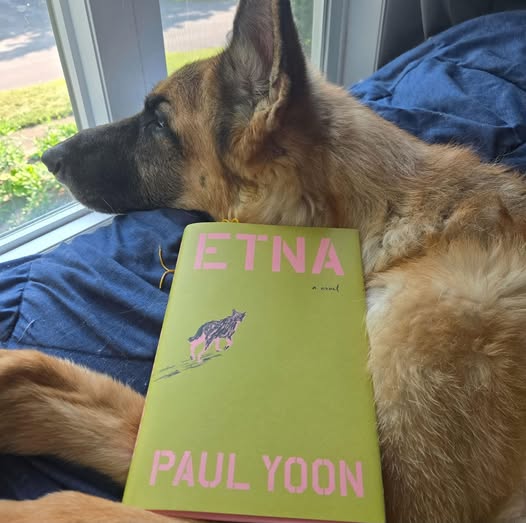
Etna by Paul Yoon is a 208 standalone novel published by Scribner in August of 2026.

Genre

Literary Fiction

Description

Beloved author and winner of The Story Prize, Paul Yoon, is back with the unforgettable story of a working dog, Etna, who, after a devastating war, embarks on an odyssey in the hopes of returning home.

Set in a fictional country in the present day, this is a story told through the eyes of an ex-military dog, Etna. After surviving years of a devastating war, Etna decides one night to leave the men he has fought alongside for years and return home—to the place where he was taken from when he was young, in the thin but persistent hope that if a home exists for him, it might be there.

Thus begins an exhilarating odyssey told through the eyes of a dog as he traverses across ruined landscapes and fights to survive in a world that, even in peacetime, proves to be just as precarious. Along the way, he encounters other animals and humans who are attempting to figure out how to start again. What makes a life when there is no home to go back to? How do we begin to trust each other again after such profound loss?

This is a novel about the power of an idea, about never giving up, and ultimately a novel about finding hope in the most dire of times.

Opening Line

I was born near water.

My Thoughts

We need friends, Etna, the bird says. We need a pack.

Even if we lose our pack, I say.

Especially because of that, she says.

Well, I knew going in that this book would ruin me. Obviously that means it’s a contender for my favorite read of the year!

When he was basically still a pup, Etna was taken from the farm by the coast where he was born to be trained as working dog for the military. After four years of helping the troops locate landmines, UEX, and IEDs, he strikes out to try to find his way back home again across a war-ravaged land.

This is a literary novel told from the dog’s POV, with no quotations around dialogue. It is very emotional, as it deals with the devastation of war, both physically and mentally.

I got injured six times. Most times it was only the graze of shrapnel or a bullet or something else small and sharp…

Fuji: she got injured five times.

As time went on, the more hurt she was, the more she wanted to hurt.

And the blue in her eyes grew less blue, and I could never explain that.

He meets others on his journey, both animals and humans, and he is the goodest boy ever.

I highly recommend reading this if you also appreciate being emotionally damaged by books.

Book Review: A FAMILY MATTER by Claire Lynch

A Family Matter by Claire Lynch is a 240 page novel from Scribner with a publish date of June 3, 2025.

Genre:

Literary Fiction

Synopsis:

An exquisite and revelatory debut novel about the devastating consequences of one woman’s affair.

1982. Dawn is a young mother, still adjusting to life with her husband, when Hazel lights up her world like a torch in the dark. Theirs is the kind of connection that’s impossible to resist, and suddenly life is more complicated, and more joyful, than Dawn ever expected. But she has responsibilities and commitments. She has a daughter.

2022. Heron has just received news from his doctor that turns everything upside down. He’s an older man, stuck in the habits of a quiet existence. Telling Maggie, his only child—the person around whom his life has revolved—seems impossible. Heron can’t tell her about his diagnosis, just as he can’t reveal all the other secrets he’s been keeping from her for so many years.

A Family Matter is a heartbreaking and hopeful exploration of love and loss, intimacy and injustice, custody and care, and whether it is possible to heal from the wounds of the past in the changed world of today.

Opening Line:

Five and a half hours after he found out he was dying, Heron drove to his favorite supermarket.

My Thoughts:

This is an emotional story of family, love, and grief. It’s based not off a specific event, but the period of UK history (recent – 1980s) when lesbians would often lose any and all access to their children, the court claiming cutting these women out of the children’s lives would protect from immorality and save them from the shame of having a gay parent and the public ridicule it might bring.

Heron has raised Maggie by himself since she was 4 years old, and the book opens with him, now in his sixties, receiving a cancer diagnosis. Chapters rotate through 4 POVs, and a big chunk of them follow Maggie, now 43 years and dealing with many things this reader found relatable – aging parents (and in her case, having to face a parent’s mortality head on), marriage along with all of its features and bugs, raising children (including a patronizing teenager), and never feeling like there is enough time.

She is prone to thoughts like this lately, about time passing too quickly, or running out altogether. About everything slipping out of her grasp. When she told Conor she felt this way, he said it was just her age, textbook midlife crisis. Maggie had advised him, on the grounds of his own health and safety, not to offer that as an explanation again.

Another line I liked:

There ought to be more to life than washing machines and emails and remembering to put the recycling out on the right day. But life is also this. It is all of this.

Other chapters follow Dawn, Maggie’s mother, in 1982. Dawn is married and has a young daughter when she meets Hazel.

Dawn couldn’t understand it, the way Hazel made her nervous. The feeling that her mouth was full of all the things she would say if she wasn’t too embarrassed to put herself into words.

An affair is scandalous enough, but two women falling in love was even more taboo at the time. In an effort to still be able to see her daughter, Dawn suffers through indignity after indignity, like the court officials grilling her on the specifics of her sex life.

There is a lot of beautiful writing in this book, but my one complaint is that it seemed uneven in its telling. The beginning had a heavy focus on Heron and his illness, and then by the end this trail of narrative seems to kind of peter out. Maggie and Dawn have chapters throughout, but last parts of the book belong much more to the two of them. And then those just sort of end as well, without much of a climax or any sort of denouement. There were also several Britishisms that threw me a bit, but obviously that is not a fault, just something to be aware of.

I wish the parts of the story, Heron’s mortaltiy/navigating family life/what makes it all meaningful, etc etc, and Dawn’s love story along with its tragic and infuriating outcome, were brought together more cohesively. As it is, it seems kind of like two separate stories, requiring one to be dropped partway though in order to tell the other. But I really did enjoy the writing and the sentiments – Heron knowing the hardest thing about his cancer is watching his daughter watch him dying, Maggie understanding that it is important and necessary for her children to grow away from her in some respects, and Dawn’s reckoning:

Later-I mean years later-I realized the worst thing had already happened to me. When I worked that out, I was invincible.

A beautiful heartache of a story that ultimately offers hope.

My thanks to NetGalley and Scribner for the eARC in exchange for my unbiased review.