Book Review: THE WITCH BELOW THE DREAMING WOOD by H.G. Parry

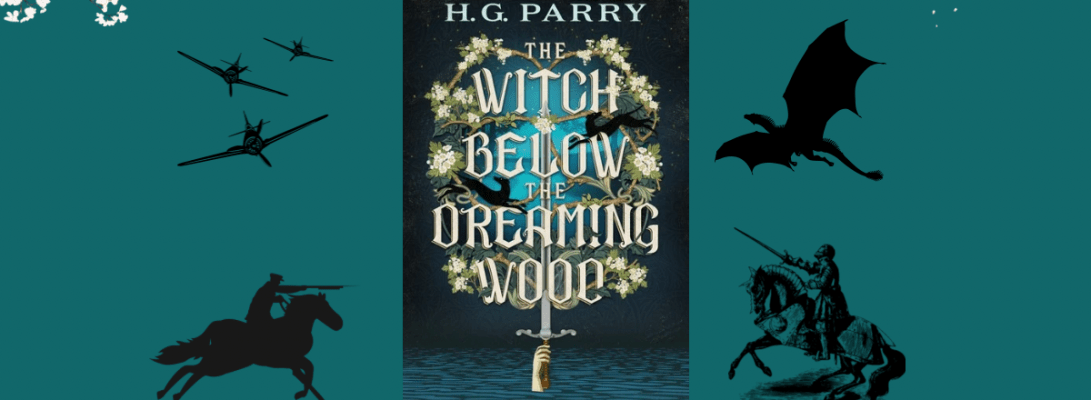
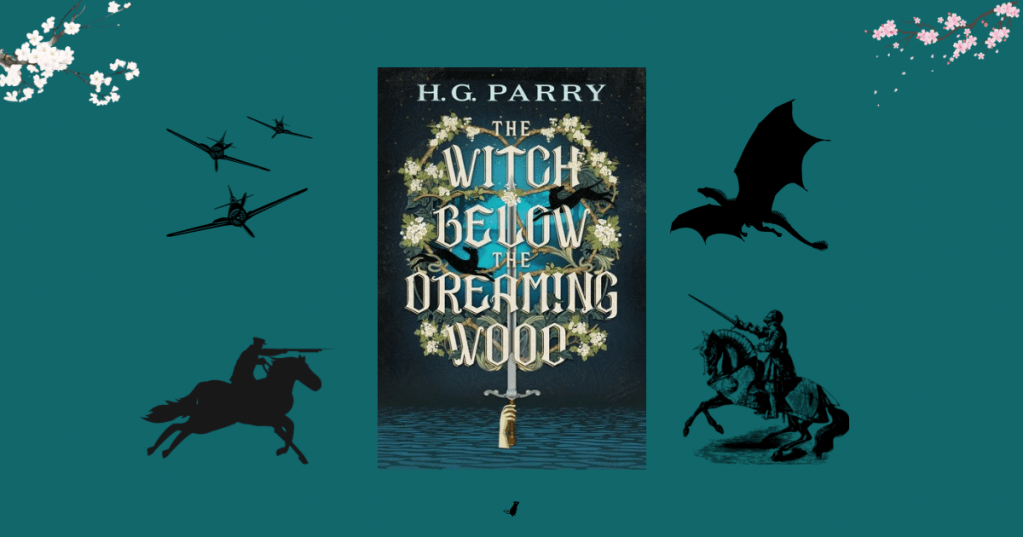
The Witch Below the Dreaming Wood by H.G. Parry is a 448 page standalone novel to be published July 21, 2026 by Redhook.

Genre

Historical Fantasy, Retelling

Description

From the author of The Magician’s Daughter comes a captivating historical fantasy where dreams come to life and Arthurian legends are reborn.

Wales, 1941. As the second world war ravages the globe and bombs fall from the sky, people all over the world begin to dream of King Arthur. The dreams spread like a fantastical plague, flooding people’s sleep night after night. Whispers arise of wonders and unexplained sights – dragons in the London Underground, and strange lights over Stonehenge. Self-proclaimed prophets claim they are miracles, heralding Arthur’s return at the time of Britain’s greatest need.⁣

Elaine Ambrose has never dreamed of Arthur, and she doesn’t believe in miracles. A librarian at the British Museum, she wants only to protect the museum’s collection from the Blitz, and is frustrated to be sent instead to catalogue a reclusive professor’s private library on the coast of North Wales. But all is not as it seems. Soon Ellie must confront what she’s tried to ignore: she dreams not of Arthur, but of Nimue – the Lady of the Lake. And her dreams promise not salvation, but a return to the darkness of the last days of Camelot. 

Opening Line

When we were children under the Lake, my other would tuck us into bed every night with the same words.

My Thoughts

“That’s the trouble with destiny, and with despair. Both make it too easy to tell yourself you had no choice.”

The Witch Below the Dreaming Wood is an Arthurian legend love story that transcends space and time.

The tale unfolds in chapters that alternate between Nimue’s story (told in the first person POV), and that of Elaine Ambrose (third person), a librarian working in London during the second World War. As their nation is embroiled in warfare, the people of the United Kingdom collectively begin dreaming about the once and future king, Arthur. Is the phenomenon spreading by the power of suggestion on the minds of a stressed population, or is there actually something otherworldly afoot?

It was as though the incendiaries had cracked open the earth and allowed something old and primal to slip through.

At first, Ellie resents being sent away from where she can be of most use to the war effort in order to catalogue the library of an isolated manor house in the north of Wales. But events at her new lodgings lead her to believe that Camlan House might in fact have a much bigger role to play in looming world-shattering events than she could have imagined. She teams up with the estate’s groom, honorably discharged RAF pilot Tom Wilder, to try to puzzle out what is behind the unearthly goings-on they witness there.

Both parts of the story were excellent, but I especially delighted at Nimue’s narration of how she was raised by the Lady of the Lake to be Merlin’s doom. Her entire life has been solely about preparing to enact her mother’s vengeance against the mighty wizard and advisor to the king in Camelot through subterfuge, never mind how Nimue herself might come to feel for the man.

Oh, the joy the repartee between Nimue and Merlin brought to me!

“As it stands, I owe you an apology, and probably an explanation. I don’t have an explanation for you, but would you like to learn how to turn into a mouse?”

“I’d better get going. I promised Arthur I’d join him in council.”

“I thought you said you were going to be completely useless this morning.”

“I never promised him I wouldn’t be useless. I never even promised him I’d be awake. I did promise him I’d be human, which is a shame, but he’s learned to be specific over the years.”

And of course we also have the other usual suspects in this part of the tale: Morgan le Fay and Mordred, Queen Guinevere and Sir Lancelot.

Poor Lancelot. So brave and so honourable, so determined to be all things to all people that he was constantly hurting them in the process… “He can’t turn aside from Arthur, and he can’t turn aside from you, and so he’s going to tear himself apart trying to be everything to both of you at once, and deep down he can’t believe that it will end badly.”

If he could be the best knight in the world while betraying his liege lord, then it meant that knighthood wasn’t what he had believed it to be. It meant that perhaps his standards meant nothing, and never had. It meant everything was falling apart.

Both strands of story weave together epically at the end. There is no time loop here, but if “timey-wimey” plots hurt your brain too much to enjoy a book, you might want to skip this one. However, if you love fantasy stories inspired by Arthurian legend, WWII historical fiction, and grand wistful romances all packaged together with strong moral lessons, you must give this a read!

It will end one day, of course. Everything does. Until then, we have the ground we hold against the dark, and the stories we fill it with.

A thousand thanks to Redhook and NetGalley for the eARC in exchange for my unbiased review.

Book Review: THOSE FATAL FLOWERS by Shannon Ives

Those Fatal Flowers by Shannon Ives is a 384 page standalone novel from Dell of Ballantine Books with a publish date of January 21, 2025.

Genre/Subgenres:

Mythology Retelling, Historical Fiction, Romance

Opening Line:

The night before Ceres’ palace becomes a tomb, it’s halls are filled with music.

Synopsis:

Greco-Roman mythology and the mystery of the vanished Roanoke colony collide in this epic adventure filled with sapphic longing and female rage—a debut novel for fans of Madeline Miller, Jennifer Saint, and Natalie Haynes.Before, Scopuli. 

It has been centuries since Thelia made the mistake that cost her the woman she loved. As the handmaidens charged with protecting Proserpina, the goddess of spring, Thelia and her sisters are banished to the island of Scopuli, cursed to live as sirens—winged half-woman, half-bird creatures. In luring men to their death, they hope to gain favor from the gods who could free them. But then ships stop coming and Thelia fears a fate worse than the underworld. Just as time begins to run out, a voice emerges, Proserpina’s voice; and what she asks of Thelia will spark a daring and dangerous quest for freedom.

Now, Roanoke. 

Thelia can’t bear to reflect on her last moments in Scopuli, where she left behind her sisters. After weeks drifting at sea, Thelia’s renewed human body is close to death. Luckily, an unfamiliar island appears on the horizon—Roanoke. Posing as a princess arriving on a sailboat filled with riches, Thelia infiltrates the small English colony. It doesn’t take long for her to realize that this place is dangerous, especially for women. As she grows closer to a beautiful settler who mysteriously resembles her former love, Thelia formulates a plan to save her sisters and enact revenge on the violent men she’s come to hate. But is she willing to go back to Scopuli and face the decisions of her past? And will Proserpina forgive her for all that she’s done?Told in alternating timelines, Those Fatal Flowers is a powerful, passionate, and wildly cathartic love letter to femininity and the monstrous power within us all.

My Thoughts:

What happens when you mix a mystery from America’s history with mythology, feminist rage, and romance?

This book right here.

It presents an interesting case: what if sirens from Greco-Roman mythology were responsible for the disappearance of the inhabitants of the lost colony of Roanoke? The author explains that her aim with this story was to explore the effects of loss and guilt on the psyche while also examining structural violence. It does a fair job in this endeavor, while also including a sapphic love story.

Our main character is Thelia, one of three sisters who acted as handmaidens to Proserpina (Persephone), and who were transformed into winged creatures to assist in the search for their charge when she was abducted by Dis (Hades). When they fail to find and rescue the goddess, they are imprisoned on an island as punishment. There, they lure sailors with their singing. (This book alternately refers to them as harpies and sirens, but I think the singing and luring part indicates they were just sirens, not harpies?)

After centuries have gone by, Thelia learns there may be a way to lift the curse she and her sisters are under, but it requires the sacrifice of many treacherous men…something the English colony of Roanoke in the Americas has more then a few of.

I liked the unique premise of the story and the bits detailing the lives of Thelia and her sister sirens on the island of Scopuli, and the writing on the sentence level was good.

On the other hand, I questioned the reliability of the behavior and speech of the Puritans depicted here. The men and women of Raleigh drank an awful lot of alcohol in this book, and said things like, “Fun little secret for you, my lady” before revealing some bit of gossip. I’m no scholar of history, but these things didn’t seem right to me. And I just wasn’t much feeling the romance — it was a bit of instalove on Thelia’s side (although in part because the object of her affections apparently looks so much like her long lost love that for a time she is trying to determine if it might actually BE her); and also, when on a timed mission for redemption, shouldn’t a centuries old divinity be able to keep it in her skirts?

All the hate for anything male really bothered me, BUT this does get addressed later on in the book, as Thelia finally learns that “monsters are made, not born”.

So while this book wasn’t a home run for me, it was decent and presents some intriguing concepts. If I were allowed half or even quarter star ratings, I’d say this was a 3.25 or 3.5 read for me.

Thank you the NetGalley and Dell/Penguin Random House for the eARC in exchange for my honest review!

Bookshop.org

Goodreads

Backlist Book Reviews

I read a couple of lovely backlist books recently!

Rhea felt better. She was still going somewhere terrible, but she had a hedgehog, dammit.

I only just “discovered” Kingfisher this year and she is already an autobuy for me, and so I am now also working through her backlist. This book did not disappoint! I do feel like it took too long to get to the meat of the story–we know our main character is engaged against her wishes because her family cannot afford to say “no” to a Lord, but it takes quite some time for her to actually arrive at this nobleman’s home and learn exactly why being his bride is even so much more of a bummer than she feared. But this is one of the author’s earlier works, and I have not noticed the same issue with any of her other books.

Once we do learn about the other wives, some of whom are not…exactly…living human beings, as well as just what is at stake, this is a darkly fun adventure as the main character races to try to save herself and the others. The resolution was bit too hurried and neat IMO, but the characters and quests undertaken are just so imaginative and…well, darkly fun!

The narration also includes some of the author’s trademark wit and humor.

She clung to the tile, and eventually she stopped screaming, because it didn’t seem to be helping.

I am so excited to read more of her work!

Beautifully written queer retelling of Arthurian legend from the POV of the knight Percival. It’s magical, it’s moving, and it’s very human at its core…while also being, you know, not fully human. The book itself, the cover and the handful of illustrations inside, are lovely!

Book Review: CLYTEMNESTRA by Costanza Casati

As for queens, they are either hated or forgotten. She already knows which option suits her better. Let her be hated forever.

This is a Greek mythology retelling focusing on Clytemnestra, wife of King Agamemnon of Mycenae, sister of Helen of Troy, cousin of Penelope of Ithaca (Odysseus’ wife). She is typically portrayed as an evil queen, but this story describes how she was wronged and betrayed, and then enacted her revenge in the name of justice.

”It is noble to be gentle, to save others from pain. But it is also dangerous. Sometimes you have to make life difficult for others before they make it impossible for you.”

The writing is fine and I was enjoying the story, but in the end it seemed rather anticlimactic to me. She waited a long time for her revenge, so long that she winds up with a whole lot more that needs avenging, and then she finally does and that’s the end.

“Listen to me,” Clytemnestra says. “Gods do not care about us. They have other concerns. That is why you should never live in the shadow of their anger. It is men you must fear. It is men who will be angry if you rise too high, if you are too much loved. The stronger you are, the more they will try to take you down.”

Overall, though, this was a deft narrative that offers a different way to consume some of the most famous stories of Ancient Greece, with a strong theme of feminism throughout (princesses of Sparta do not meekly submit to the wills of others!)

Bookshop

Bookstagram

Goodreads