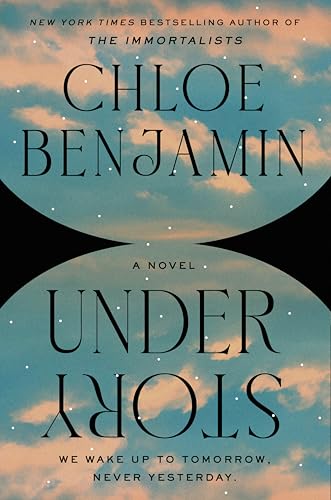
Under Story by Chloe Benjamin is a 512 page standalone novel published by G.P. Putnam’s Sons in 2026.
Genre
Literary Fiction, Speculative Fiction, Science Fiction
Description
The New York Times bestselling author of The Immortalists returns with an intimate yet epic love story—and a sweeping odyssey of scientific discovery. Under Story invites us to consider the promise of this life, what might lie beyond it, and how far we would go for more time with the people we love, cementing Chloe Benjamin’s place among our best, and most lasting, storytellers.
“We wake up to tomorrow, never yesterday.”
At the end of the world, biologist Laurel Salter is hiding from everything she’s ever known. For ten hours a day, six days per week, she works as a dishwasher at McMurdo Station, an isolated research base in Antarctica. She tells no one that before she arrived, she was a renowned young scientist with a promising career, a husband, and a family.
But even in this remote outpost, Laurel can’t outrun her past. When a strange light appears across the ice—and draws a group of physicists to McMurdo—her former husband, Eli, won’t be far behind.
Laurel is captivated by the Arc: its surreal glow; the way it seems almost alive. And though Eli is reluctant to test her wildest theory, Laurel is convinced that the Arc leads down a rabbit hole, and into a world, they can barely imagine. Can she persuade him to risk everything to fix the burden that hangs between them—to turn back the clock and live their story a second time?
A breathless page-turner and a love letter to our planet, Under Story grapples with the great questions of our time: human hubris, the precarity of the natural world, and the mysterious webs of consciousness that bind us. A modern epic of science and soul, of bravery and redemption, it offers a vision of the future that demands we reckon with what we owe to one another, and to the earth itself.
Opening Line
Laurel’s first memories of soil–though at the time, she would have called it dirt–came from weeding in her mother’s garden.
My Thoughts
She must remind herself that words like beginning and end, one and two, are a matter of perspective. A line implies before and after; a circle says, And then, and then…
Laurel is a mycologist who leaves her university professorship to wash dishes at a research station in Antarctica after a tragedy leads to the dissolution of her marriage. The isolation and stark beauty of the location suits her, and she makes some good friends. Then a color-changing Arc appears over the icy expanse. Her ex-husband Eli is one of the physicists sent to study the unexplained phenomenon, and the two of them eventually realize the Arc might in fact represent the second chances in life that they had been hoping for.
This reflective and emotional book uses speculative science fiction as a tool to closely examine life, love, and grief. The author incorporated things that have caught her fancy throughout her life as building blocks to craft this moving tale: namely the interconnectedness of all lifeforms (highlighted most particularly here with the relationship between trees and fungi), and results from research performed in Antarctica linked to a theory of a mirror universe. If such a thing were to exist, what kind of opportunities might it present?
Maybe catastrophizing is like freezing a photon in flight: if you fixate on one outcome, all of the others collapse. That’s what fear does, she thinks. It makes you pick a story. If the stays open, the future might hold everything at once.
The beginning of the book (Laurel going to the ends of the Earth to escape her known life with its painful truths) was very good, and the end was pretty excellent (considering topics such as what makes for a meaningful life, and what is “enough”), but the story did drag a bit for me in the middle. I also side-eyed a few details here and there. Even still, I teared up several times during its telling, which for this reader is a sign of success!
And how absurd it is, the bargain of life: that we should be gifted love while guaranteed loss, love’s tax.
This book asks the question, how far would you go to get more time with a lost loved one? I don’t think this will be an all-time favorite like Benjamin’s The Immortalists was for me, but is definitely a strong contender for one of my favorite reads of the year. (And considering these books in conjunction–wow, can this author write, but man, who did she lose?)
Major content warning here for the death of a child


