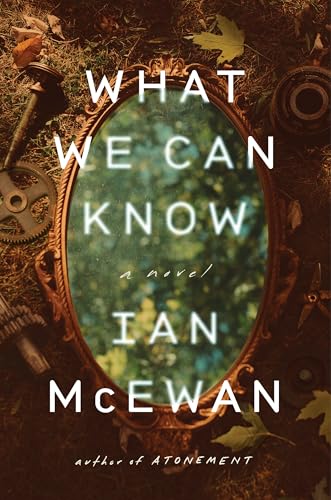
What We Can Know by Ian McEwan is a 320 page novel published by Knopf in 2025.
Genre:
Literary Fiction, Speculative Fiction
Synopsis:
2014: A great poem is read aloud and never heard again. For generations, people speculate about its message, but no copy has yet been found.
2119: The lowlands of the UK have been submerged by rising seas. Those who survive are haunted by the richness of the world that has been lost.
Tom Metcalfe, an academic at the University of the South Downs, part of Britain’s remaining island archipelagos, pores over the archives of that distant era, captivated by the freedoms and possibilities of human life at its zenith. When he stumbles across a clue that may lead to the lost poem, a story is revealed of entangled loves and a crime that destroy his assumptions about people he thought he knew intimately well.
What We Can Know is a masterpiece, a fictional tour de force that reclaims the present from our sense of looming catastrophe, and imagines a future world where all is not quite lost.
Opening Line:
On 20 May 2119 I took the overnight ferry from Port Marlborough and arrived in the late afternoon at the small quay near Maentwrog-under-Sea that serves the Bodleian Snowdonia Library.
My Thoughts:
This is a story in two parts.
The part readers are presented with first takes place one hundred years in the future (which is chronologically after the second part). A university history professor is researching a “lost” poem from 2014 (I think; thereabouts, at least). The poet wrote it for his wife, recited it at a dinner party for her birthday, and then gifted her the only copy of it in writing. It was never published, but became famous by word of mouth and by dint of the air of mystery created by its absence, and the rumors created thereby. Going through all the primary records from the time period before the cataclysmic climate crisis has the historian reading all of the emails and text messages of the poet and everyone in his circle. He also reads the journals of the poet’s wife, Vivien. He believes he has come to know this woman as intimately as a close friend. But then the second part of the story is a sort of memoir of Vivien’s, and it goes to show just how limited one’s understanding of another person can really be when going only by the material evidence left in their wake.
Honestly, the first half of book was pretty rough. I was enjoying the story and the narrative conceit, but the style it was written in was a bit of a challenge to get through. It was pretty dry at times, with long blocks of text of information that had my eyes glazing over. Several times during this part of the story I found my mind had wandered and I was just skimming the words – sometimes I bothered to go back and reread what I missed, sometimes I didn’t.
But the payoff of the second half, and what it does to the first, was worth it. Seeing Vivien’s truth juxtaposed to the interpretation of an academic a century later was a nice touch.
Note: You may want to skip this one if you have a loved one with dementia! Also if you require likeable characters (the first part had these, the second did not other than the one with Alzheimers, and that is a ROUGH storyline)
 Jessica Crawford