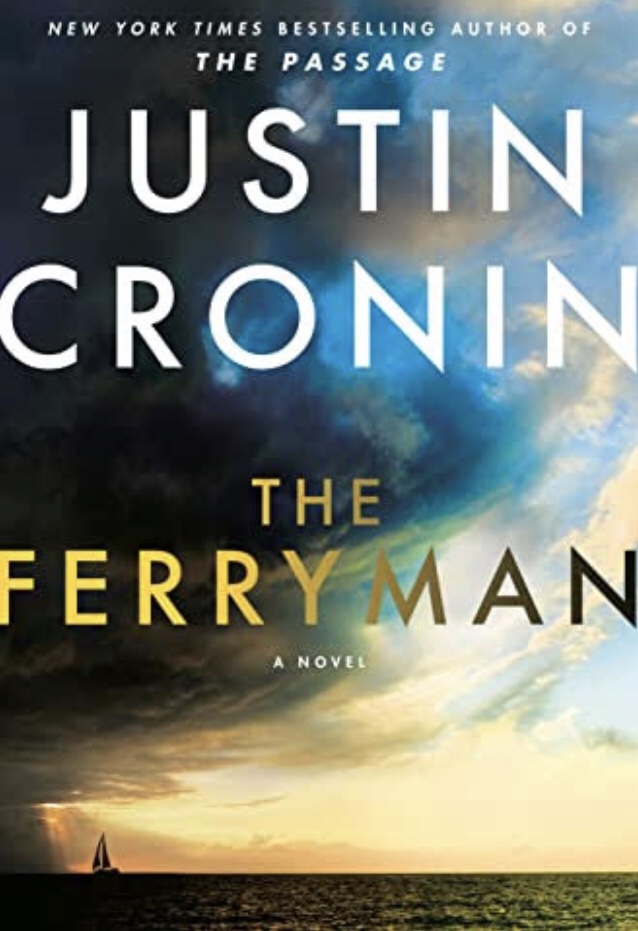
Book Review: THE FERRYMAN by Justin Cronin

From Justin Cronin, author of The Passage trilogy, comes a science fiction standalone, The Ferryman.

The end had been ordained in the beginning, the way the final chord was built into the first measure of a symphony

The people of Prospera aren’t sure what lays beyond the Veil that surrounds their archipelago state, but they know they’re lucky to be where they are. Prosperans live out idyllic lives, retire to the Nursery when their bodies begin to fail them, are overhauled both physically and mentally, then get reiterated into society as blank slates. This isn’t the case for support staff from the Annex, however, who perform menial labor for the Prosperans, while everyone is controlled by a police state. This world is dystopian for just as many as it is a seeming utopia for others. But how were these lines drawn?

I got The Truman Show vibes from the early parts of this book, not in tone, but in knowing that the world is not what it seems. But in this case, the reader is as clueless as to the truth as are all the characters. Most Prosperans are content in their ignorance, living happy life after happy life, though they may lack real love or anything to make it at all meaningful. On the other hand, the people of the Annex have built a religion around the idea of a day of Arrival (who will be arriving where?), and some people, like protagonist Proctor Bennett, want to learn the truth after being plagued by troubling dreams that are echoes of past iterations.

It was what the world taught us to do, but it was no way to live, and now, for the first time, I felt like I was waking up.

Proctor finds himself in league with others who are not satisfied with the status quo. Can they find their way out of what, for all intents and purposes, is the world itself? If so, what will they find outside its limits?

This book features some beautiful writing. I really loved it in the beginning, it fizzled out a bit for me in the middle, but then the final revelations were pretty good. I definitely had some questions, but to list them here would be spoilery. Overall it’s very well done.

TW: death of a child, suicide, adultery

Bookshop.org

Bookstagram

Goodreads

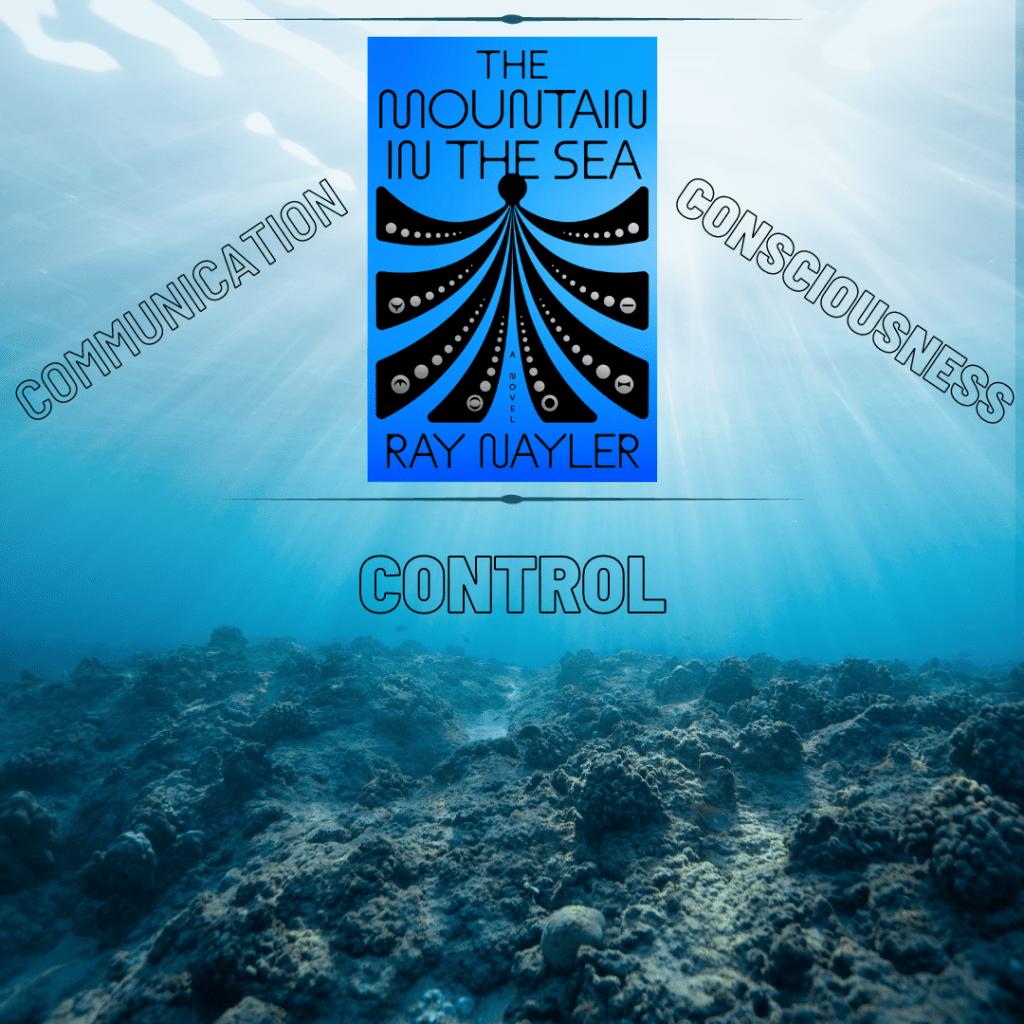
Book Review: THE MOUNTAIN IN THE SEA by Ray Nayler

🐙 Come for the octopuses, stay for the story about communion, consciousness, and control!

The Mountain in the Sea is science fiction set in a near future when many industries are fully automated with AI. The Con Dao archipelago of Vietnam is a wildlife sanctuary for many species, including octopuses so intelligent they just might rivals humans. A tech corporation with a vested interest in seeing what can be learned from these animals has sent in researchers and sealed the area off, protecting it by deadly means if necessary.

The characters that this book primarily follows are:

Ha Nguyen, a marine biologist who struggles with the indifference people feel for the things that don’t personally affect them, and who learns the importance of connection, making oneself understood, and striving to understand others even if it doesn’t mean always agreeing with each other.

Rustem, a Tartar hacking genius who may have gotten involved in something bigger than he realized.

Eiko, a young Japanese man enslaved on an automated fishing rig.

Other characters include a badass mercenary security specialist from a nunnery, a scientist seeking mastery of creating consciousness in an attempt to fend off her own loneliness, and an android whose very existence puts them at risk from those who feel threatened by the idea of a nonhuman mind. Some of the verbal exchanges between the android and the security agent were a joy, very funny!

The octopuses feature a lot less in this book than I thought they would – I mean, a good portion of it is ABOUT the octopuses, but they actually only show up in a handful of scenes. It’s more about the people studying them, and how the world both exist in has been shaped by conscious ingenuity and all the good and bad it creates.

Bookshop.org

Bookstagram

Goodreads

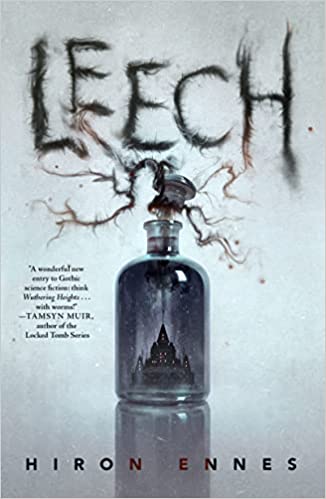
Book Review: LEECH by Hiron Ennes

Leech by Hiron Ennes is Gothic horror set in a post-apocalyptic future. After climate disaster and the backfiring of man-made technology drove people underground, they finally resurfaced when it was safe(ish) and rebuilt, reclaiming some of the knowledge that was lost through records that were spared.

The main character is actually a gestalt intelligence formed by a parasite that takes control of the human hosts it infects. It hoards the world’s recovered medical knowledge for job security, in order to stay relevant and needed by humanity, and to maintain its evolutionary niche.

While working as a doctor for the draconian baron in the frozen wilds of the North (stalked by beings with unknown origins, but plenty of mythological possible origin stories), they discover a new (probably ancient but newly resurfaced) parasite that threatens everything.

The world-building here is truly impressive!

Of course the baron lives in a crumbling chateau and his family is comprised of a strange cast of characters (and ghosts?). Consent and bodily autonomy are big players in the story that unfolds.

Not for the faint of heart, this tale is creative, creepy, and really quite wonderful! I can’t wait to see what this author does next.

Between this book, Mexican Gothic, and What Moves the Dead, I’ve learned that apparently parasite horror is my jam!

Bookshop.org

Bookstagram

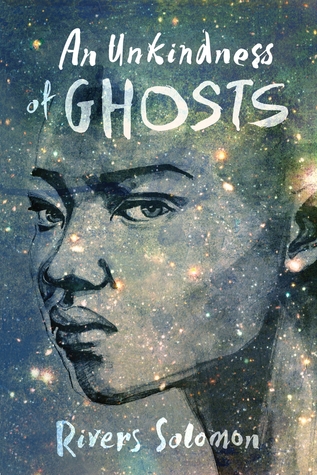
Book Review: AN UNKINDNESS OF GHOSTS by Rivers Solomon


Odd-mannered, obsessive, withdrawn, Aster has little to offer folks in the way of rebuttal when they call her ogre and freak. She’s used to the names; she only wishes there was more truth to them. If she were truly a monster, as they accuse, she’d be powerful enough to tear down the walls around her until nothing remained of her world, save for stories told around the cookfire.

Aster lives in the low-deck slums of the HSS Matilda, a space vessel organized much like the antebellum South. For generations, the Matilda has ferried the last of humanity to a mythical Promised Land. On its way, the ship’s leaders have imposed harsh moral restrictions and deep indignities on dark-skinned sharecroppers like Aster, who they consider to be less than human.

When the autopsy of Matilda‘s sovereign reveals a surprising link between his death and her mother’s suicide some quarter-century before, Aster retraces her mother’s footsteps. Embroiled in a grudge with a brutal overseer and sowing the seeds of civil war, Aster learns there may be a way off the ship if she’s willing to fight for it.


“All that was left were the taunts, and the crack of Scar’s knee, and the past swooping in, an unkindness of ghosts. Her old life had possessed her, strengthening her, but like everything else, used her up and then was done.”

Well I thought this book was pretty great!

The setting is one thing that didn’t work all that well for me, as I never could grasp the details of the spaceship Matilda – its size and layout, the population aboard, how it sustained…well, everything. It runs on autopilot and (almost) no one is paying attention to its trajectory. We also never know how exactly it came to be that a society capable of launching a generation ship into space and sustaining its population for centuries had also managed to backtrack to the point of organizing society in a way just like that of the antebellum South.

But I was able to look past that and very much enjoyed the story set within those parameters. Aster, a black intersex autistic alchematician, is such a great character. Taking everything at face value, her authenticity is a delight. Her relationship with the Surgeon/the Hands of the Heavens/the queer ascetic bastard child of the former Sovereign and one of the black lowdeckers, is nothing short of wonderful. The plot of this story revolves around Aster following the clues left behind by the mother who died shortly after birthing her, the mechanic who may have found a way to leave Matilda behind and make it to a better world.

“A scientist, Aster had learned something Giselle had not: decoding the past was like decoding the physical world. The best that could be hoped for was a working model. A reasonable approximation. That was to say, no matter what Aster learned of Lune, there was no piecing together the full mystery of her life. There was no hearing her laugh or feeling her embrace. A ghost was not a person.”

This book was troubling to read at times, as it deals with abuses of nearly every kind. I actually choked up when Aster broke down, saying, ‘”Nobody is allowed to touch me. Nobody’s allowed to call me names. I’m alive,” she sobbed out. “I’m alive.”‘ This in reference to her recent line of thinking about every living thing being owed the same basic respect.

“People like this guard tried so hard to make Aster feel lesser, but some days, like today, it didn’t work, because she saw clearly how superior she was.”

If you can suspend disbelief about the details of the setting, and you can stomach the non-gratuitous but plentiful scenes of violence and implied sexual assault, I recommend taking this journey with Aster. You might be surprised at where you wind up.

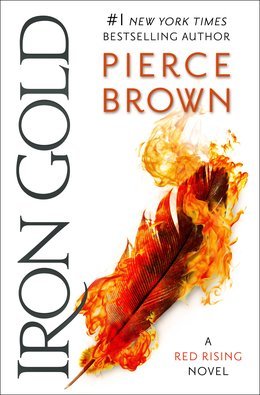
Book Review: IRON GOLD by Pierce Brown

Iron Gold

A decade ago, Darrow was the hero of the revolution he believed would break the chains of the Society. But the Rising has shattered everything: Instead of peace and freedom, it has brought endless war. Now he must risk everything he has fought for on one last desperate mission. Darrow still believes he can save everyone, but can he save himself?

And throughout the worlds, other destinies entwine with Darrow’s to change his fate forever:

A young Red girl flees tragedy in her refugee camp and achieves for herself a new life she could never have imagined.

An ex-soldier broken by grief is forced to steal the most valuable thing in the galaxy—or pay with his life.

And Lysander au Lune, the heir in exile to the sovereign, wanders the stars with his mentor, Cassius, haunted by the loss of the world that Darrow transformed, and dreaming of what will rise from its ashes.

Red Rising was the story of the end of one universe, and Iron Gold is the story of the creation of a new one. Witness the beginning of a stunning new saga of tragedy and triumph from masterly New York Times bestselling author Pierce Brown.

A thrilling and action-packed book that sets us up for a new branch of Red Rising story to tell.

Brown does a good job at the multiple-narrator thing, the POV switching with each chapter. We follow along with Darrow, Lysander au Lune (grandson of the Sovereign whose regime was toppled in the revolution), Lyria of Lagalos (a Red released from the mines when the Society crumbled at Mustang and Darrow’s feet), and Ephraim ti Horn (a Gray thief who was once engaged to marry a character familiar to readers of Morning Star). We see more of those we’ve come to know in the previous three books, such as Sevro, Victra, Sefi, Cassius, and the wonderful character of Romulus au Raa.

They planted us in stones, watered us with pain, and now marvel how we have thorns.

I’ve seen the writing in this book compared to that of George R.R. Martin in ASOIAF, but I take one exception to that – our heroes fall on hard times here, and yes, it sets us up for the new trilogy, but what Martin does differently that works so well is to throw the protagonists a bone every once in a while as well. Sure, he usually lifts them up just so they can crash down all the harder, but here we didn’t even get those instances to feel good about the way things were going for once. The more to invest you in reading on in the series, I suppose, but I think Martin’s method is more effective.

Still, Brown knows how to spin an exciting tale. In addition to his storytelling, he has a beautiful way with words.

Love is the stars, and its light carries on long after death.

If you were a fan of the original Red Rising trilogy, I fail to see how you could be disappointed with Iron Gold.

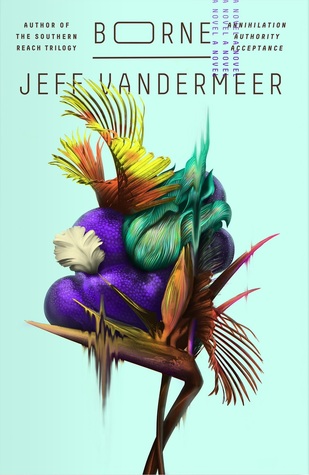
Book Review: BORNE by Jeff Vandermeer


Borne
“Am I a person?” Borne asked me.

“Yes, you are a person,” I told him. “But like a person, you can be a weapon, too.”

This was a wild dystopian speculative fiction story that asks some important questions and is quite touching at times. The land has been laid to waste by drought, conflict, and loosed biotech from the now-defunct Company. Rachel and Wick team up to take a stab at survival in this newly arranged city, and a real sense of tension is conveyed. Wick tries to maintain a hold on their territory through the dealing of information as well as his own psychoactive biotech, while Rachel scavenges for salvage off of which they can live. It’s during one of her outings that she finds something rather extraordinary.

This book left me bit confused as to the details of some of the science fiction elements. The who, what and why of the Company was never made clear, nor were specifics of some of the biotech it turned out. I think this was mostly a conscious choice by the author, but it did leave me a bit unsatisfied. Near the end I realized that the character of Mord had once been human, and it seemed like that fact had been revealed much earlier but I had somehow managed to either miss it or else forget it completely. The fact that the giant and vicious flying bear used to be human, and a former coworker of Wick’s at that, seems like a point that should be too significant to be missed/forgotten.

The story does many things right, though, and the best part by far was Borne himself – sweet and innocent and endlessly amusing.

“Those are three dead skeletons on the wall, Borne.”

“Yes, Rachel. I took them from the crossroads. I thought they would look nice in here.”

And yes, I maintain a belief in Borne’s inherent innocence. (And as it says in the book’s blurb, “in a world so broken that innocence is a precious thing.”) Borne simply does what he was designed to do, but because Rachel raises him with a human’s sensibilities, he feels great guilt and shame about his own nature. Which gives me all the feels!

“We all just want to be people, and none of us knows what that really means.”

And I sincerely hope to be able to subscribe to a book box someday(when I’m not so broke), because it turns out Quarterly’s most recent fiction Literary Box was curated by Vandermeer and included some of his own drawings of just what Borne looks like in some of his many forms. How fun is that?!


If you like science fiction of the speculative and dystopian variety, amusing plant/animal/salvage/biotech thingies, and The Feels, then give this one a read!