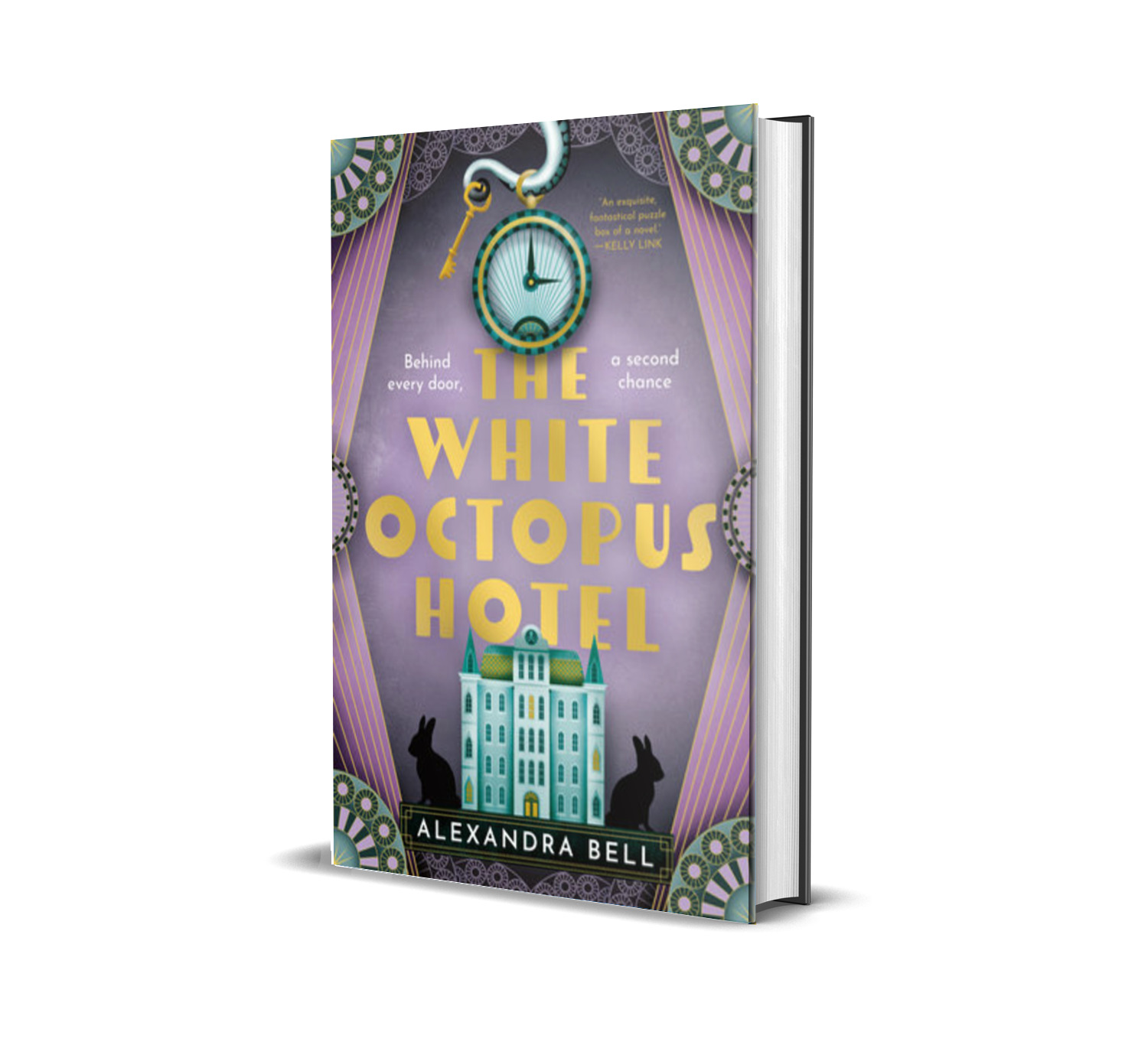
Book Review: THE WHITE OCTOPUS HOTEL by Alexandra Bell

The White Octopus Hotel by Alexandra Bell is a 369 page standalone novel with a publish date of 10/28/25 by Del Rey

Genre:

Fantasy/Magical Realism

Subgenres:

Historical Fiction, Romance

Blurb:

Journey to a magical hotel in the Swiss Alps, where two lost souls living in different centuries meet and discover that behind its many doors, they may just find a second chance.

‘Have you travelled a long way?’ she asked carefully. A smile twitched at the corner of his mouth. ‘Well, yes,” he said slowly. ‘Yes, you could say that. But it was worth the wait.’

London, 2015

When reclusive art appraiser Eve Shaw shakes the hand of a silver-haired gentleman in her London office, the warmth of his palm sends a spark through her.

His name is Max Everly – curiously, the same name as Eve’s favourite composer, born one hundred sixteen years prior. And she can’t shake the feeling that she’s held his hand before . . . but where, and when?

The White Octopus Hotel, 1935

Decades earlier, high in the snowy Swiss Alps, Eve and a young Max Everly wander the winding halls of the grand belle epoque White Octopus Hotel, lost in time.

Each of them has been through the trenches – Eve in a family accident and Max on the battlefields of the Great War – but for an impossible moment, love and healing are just a room away . . . if only they have the courage to step through the door.

Opening Line:

Eve didn’t want to turn around because then she would see it.

My Thoughts

What a special story this was about regret and finding a steady hand to hold yours in the dark! It’s got:

✓ A magical hotel
✓ Time travel
✓ Scavenger hunt/puzzles
✓ Working through grief

Eve Shaw is haunted (quite literally) by a tragic event from her childhood, and she would do anything to change what happened. When she finds herself transported back in time to a magnificent hotel known to house various magical objects, she might just get that chance.

I will say that I think this book took too long setting up before starting the meat of the story. Even without reading the synopsis, the story has the reader expecting Eve to travel to the White Octopus Hotel and to the past, but this doesn’t actually happen until around 40% into the book. Up until that point I thought the book was just fine, but that’s when it got good–and then, as I read on, it wound up being something rather extraordinary!

We have Eve, an artwork appraiser at an auction house in 2016 whose octopus tattoo moves itself around her body at will, and who finds herself participating in a scavenger hunt at the White Octopus Hotel in 1935 for the chance to win a magical object that could allow her to rewrite her past.

And then we have Max Everly, music composer and junior officer in World War I who is sent to the hotel in the Swiss Alps in 1918 to convalesce as a POW.

These two meet multiple times throughout history (but it’s always only the first time for one of them!) The bond between them acts as a light in each of their lives, and “after all, a single candle could make all the difference in the dark”. Eve eventually is forced to reckon with the knowledge that changing her own story will have consequences that ripple through time. Either way, someone she cares for is going to have to get hurt.

I really loved the specifics of the different magical aspects in this story. Was I left with some questions, for logistics? Sure. But the helpful tentacles, the creepy yet sympathetic Eavesdropper, the war horse returning lost objects in the steam baths–delightful!

Personally, I don’t usually appreciate comps because so often they set me up for disappointment, but for readers who look for that kind of information I will say that this book had me at different times feeling hints of The 7 1/2 Deaths of Evelyn Hardcastle and The Warm Hands of Ghosts vibes.

In all I found this to be an exciting, touching, and hopeful magical love story with an overall theme of making peace with the past. I plan to check out more of this author’s work for sure.

Now, if I may share a couple of quibbles, which obviously were not egregious enough to drop my rating from 5 splendid stars. The writing itself was not bad by any means, but it was just a bit basic. And this last bit could be considered a tad spoilery, so please avoid if that bothers you, but it was odd to me that Eve, despite already having a crush on Max before meeting him, did not form any romantic feelings for him when she knew him in his thirties and he pledged to help her with whatever she needed, but then fell in love with him while he was a traumatized teenager in the midst of a mental health crisis. This seemed a bit ick to me.

THANK YOU SO MUCH to Del Rey and NetGalley for the eARC in exchange for my unbiased review!

Goodreads

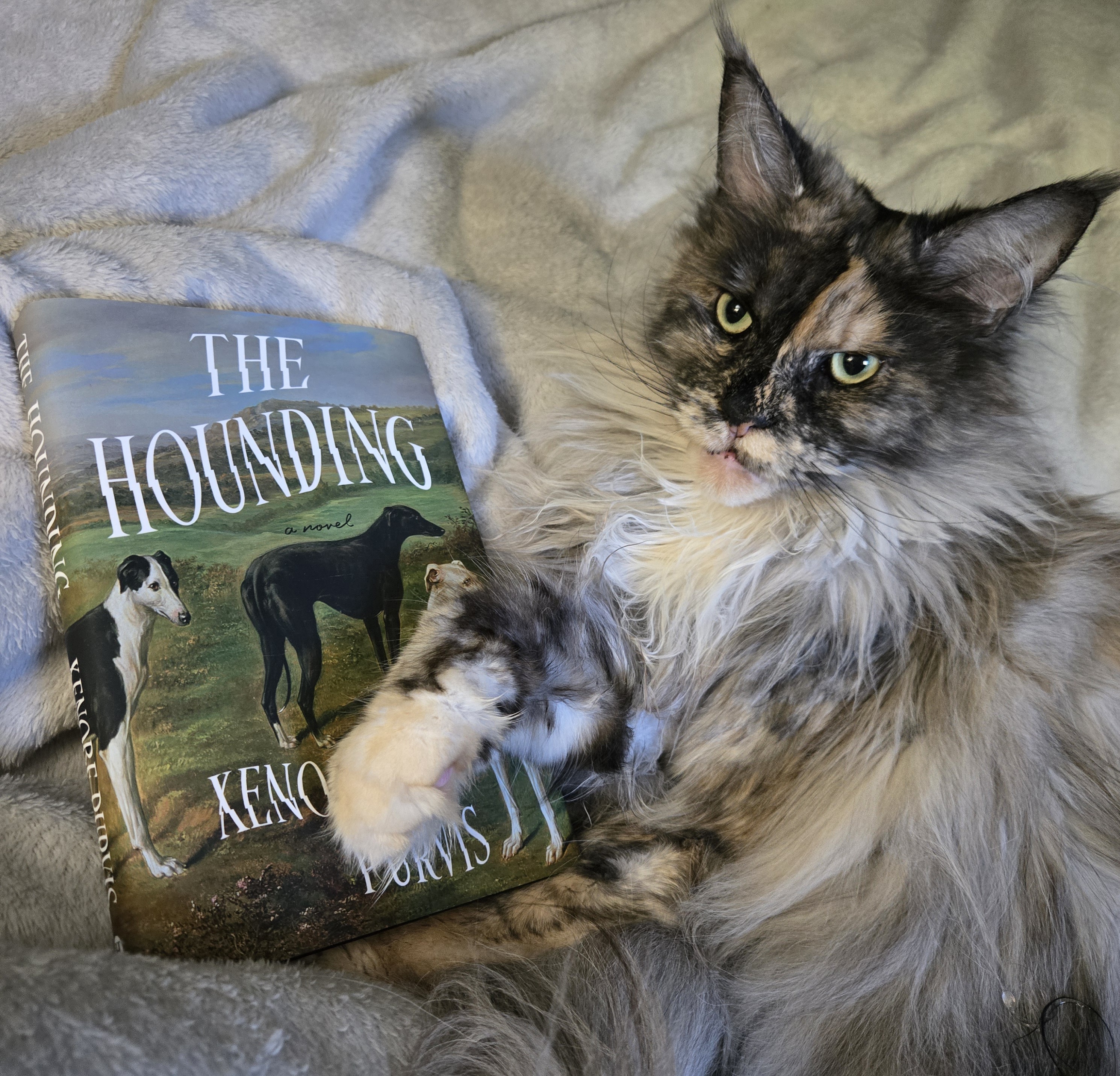
Book Review: THE HOUNDING by Xenobe Purvis

The Hounding by Xenobe Purvis is a 240 page debut novel published in 2025 by Henry Holt and Co.

Genre:

Literary Fiction, Historical Fiction

The Blurb

Even before the rumors about the Mansfield girls begin, Little Nettlebed is a village steeped in the uncanny, from strange creatures that wash up on the riverbed to portentous ravens gathering on the roofs of people about to die. But when the villagers start to hear barking, and one claims to see the Mansfield sisters transform before his very eyes, the allegations spark fascination and fear like nothing has before.

The truth is that though the inhabitants of Little Nettlebed have never much liked the Mansfield girls—a little odd, think some; a little high on themselves, perhaps—they’ve always had plenty to say about them. As the rotating perspectives of five villagers quickly make clear, now is no exception. Even if local belief in witchcraft is waning, an aversion to difference is as widespread as ever, and these conflicting narratives all point to the same ultimate conclusion: something isn’t right in Little Nettlebed, and the sisters will be the ones to pay for it.

As relevant today as any time before, The Hounding celebrates the wild breaks from convention we’re all sometimes pulled toward, and wonders if, in a world like this one, it isn’t safer to be a dog than an unusual young girl.

Opening Line:

The girls, the infernal heat, the fresh-dead body.

My Thoughts:

“Wherever we go, however we behave, there’ll always be something to drive us inside. That’s where people want us to be.”

The Crucible meets The Virgin Suicides in this haunting debut about five sisters in a small village in eighteenth-century England whose neighbors are convinced they’re turning into dogs. — For once I think the comp offered by the publisher is an apt one and not just marketing nonsense.

The atmosphere in this book is set perfectly, with the people of Little Nettlebed set on edge by the hot baking sun and the drought negatively impacting livelihoods. The five Mansfield sisters are unconventional, and a delusionally arrogant neighbor becomes obsessed with putting them in their place. Mob mentality takes over the villagers, even affecting those who try their hardest to resist.

I think the themes of this story are explored wonderfully. I also think the characterization is well done, it’s just that the manner of storytelling doesn’t allow the reader to delve too deeply into any single character. Third person POVs shift among five different villagers throughout the book, and we get a good sense of each of them. But the story revolves around their interactions with and feelings about the Mansfield sisters, whose own POVs we do not get directly. I thought this was the perfect way to tell their story.

He searched within his soul and saw a terrible truth: that he’d rather they were dogs than damaged girls…He’d rather they were free than confined…

I included this book in my spooky season reading not because it’s horror (it’s not) or brings autumn feels to life on the page (nope), but for the witch hunt vibes, and in this it did not disappoint!

Disclaimer: Maine Coon cat Freya does not approve of any hounding whatsoever

Goodreads

Bookstagram

Book Review: AMITY by Nathan Harris

Amity by Nathan Harris is a 320 page standalone novel published in 2025 by Little, Brown and Company of Hatchette Book Group.

Genre:

Historical Fiction

Synopsis:

A gripping story about a brother and sister, emancipated from slavery but still searching for true freedom, and their odyssey across the deserts of Mexico to finally reunite, all while escaping a former master still intent on their bondage

New Orleans, 1866. The Civil War might be over, but formerly enslaved Coleman and June have yet to find the freedom they’ve been promised. Two years ago, the siblings were separated when their old master, Mr. Harper, took June away to Mexico, where he hoped to escape the new reality of the post-war South. Coleman stayed behind in Louisiana to serve the Harper family, clinging to the hope that one day June would return.

When an unexpected letter from Mr. Harper arrives, summoning Coleman to Mexico, Coleman thinks that finally his prayers have been answered. What Coleman cannot know is the tangled truth of June’s tribulations under Mr. Harper out on the frontier. And when disaster strikes Coleman’s journey, he is forced on the run with Mr. Harper’s daughter, Florence. Together, they venture into the Mexican desert to find June, all the while evading two crooked brothers who’ll stop at nothing to capture Coleman and Florence and collect the money they’re owed. As Coleman and June separately navigate a perilous, parched landscape, the siblings learn quickly that freedom isn’t always given—sometimes, it must be taken by force.

As in his New York Times bestselling debut The Sweetness of Water, Nathan Harris delves into the critical years of the Civil War’s aftermath to deliver an intimate and epic tale of what freedom means in a society still determined to return its Black citizens to bondage. Populated with unforgettable characters, Amity is a vital addition to the literature of emancipation.

Opening Line:

I had few pleasures to call my own.

My Thoughts:

This is a work of historical fiction taking place in the American South and Mexico in the years immediately post-Civil War. POVs alternate between siblings Coleman and June, servants of the family who owned them as slaves before the North’s victory freed them. Still stinging from the Confederacy’s loss, the patriarch of the family takes June with him as he joins a group of other disgruntled Southerners who travel to Mexico in order to establish a new mining town and get out from the under the laws of the Union. Later, the man’s wife and daughter, along with Coleman and the family dog, strike out to join them. The journey presents a multitude of dangers and interesting characters – criminals, Mexican soldiers, Black Seminoles, and others.

What I liked about this book included the setting and atmosphere. There is the harsh beauty of the desert, the chapparal and mesquite trees beneath the baking sun, but also the towns strung along their path south, which reminded me of being ensconced in the world of Red Dead Redemption 2. This video game takes place about 30 years later, but I could easily picture Arthur Morgan and his outlaw companions riding their horses through the territories of this book.

Also enjoyable was the character of Coleman, a former slave and current servant who is happiest lost in the pages of his books, taught himself academics and proper comportment both from the books assigned to the daughter of his employers for her education, and who has a sweet bond with the book’s canine character, Oliver. Additionally, there is a side character who exhibits some nice personal growth.

What didn’t work so well for me is a bit harder for me to name. I just wasn’t that engaged in the plot, which meandered at times (particularly during June’s page time) without a real sense of urgency or expected destination, figuratively speaking. In this way I suppose the pacing was a bit off, and I certainly wouldn’t use the word “gripping” to describe my own reading experience. At the conclusion of the book I thought to myself, “Well that’s nice,” but it really isn’t anything that I anticipate staying with me for long now that I have finished reading. I guess I appreciated the vibes more than the story. 

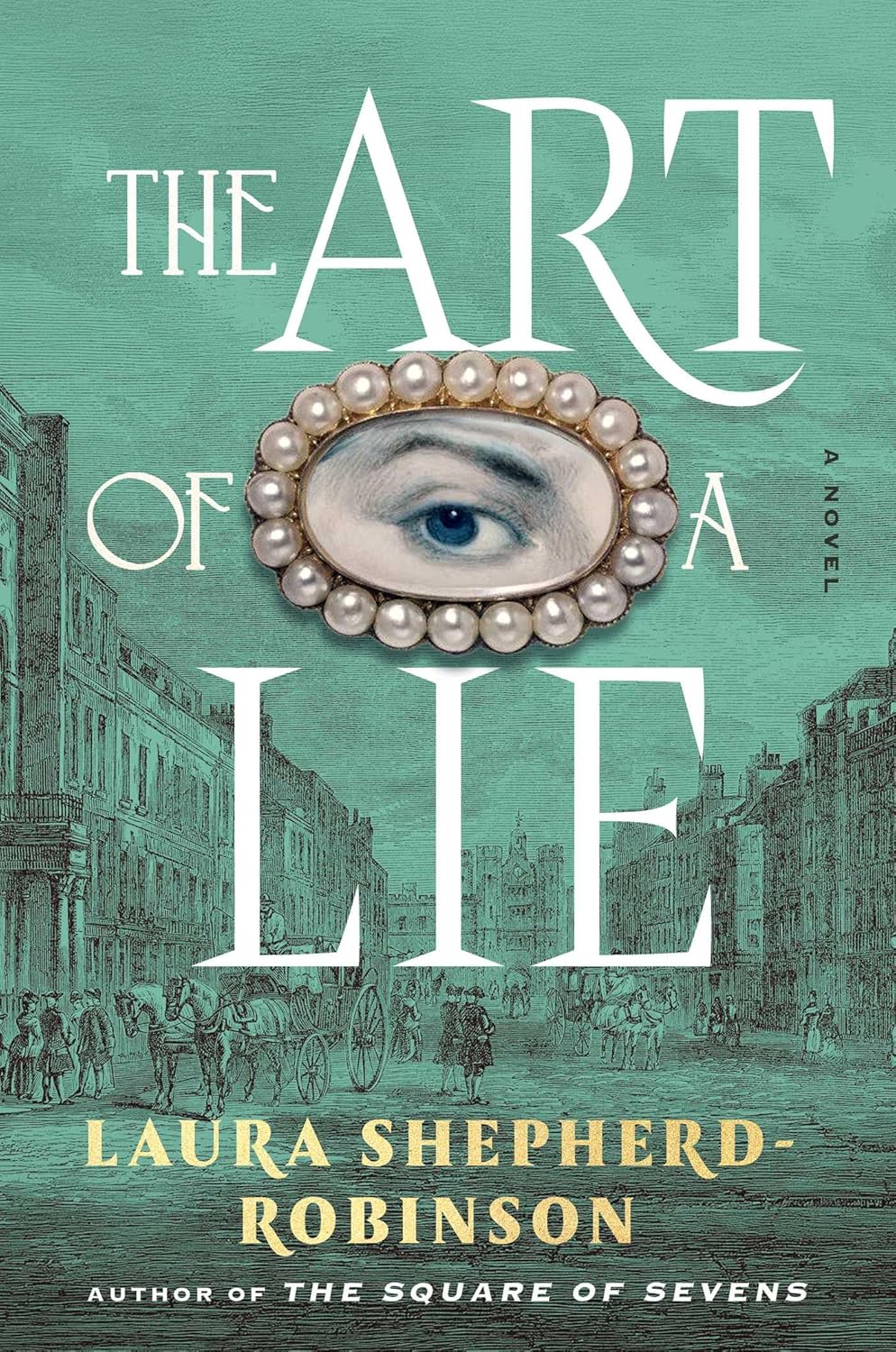
Book Review: THE ART OF A LIE by Laura Shepherd-Robinson

The Art of a Lie by Laura Shepherd-Robinson is a 304 page standalone novel published in 2025 by Atria Books.

Genre:

Historical Fiction

Subgenres:

Mystery, thriller

Synopsis:

In 18th-century England, a widowed confectioner is drawn into a web of love, betrayal, and intrigue and a battle of wits in this masterful historical novel from the author of the USA TODAY bestseller The Square of Sevens.

Following the murder of her husband in what looks like a violent street robbery, Hannah Cole is struggling to keep her head above water. Her confectionary shop on Piccadilly is barely turning a profit, her suppliers conspiring to put her out of business because they don’t like women in trade. Henry Fielding, the famous author-turned-magistrate, is threatening to confiscate the money in her husband’s bank account because he believes it might have been illicitly acquired. And even those who claim to be Hannah’s friends have darker intent.

Only William Devereux seems different. A friend of her late husband, Devereux helps Hannah unravel some of the mysteries surrounding his death. He also tells her about an Italian delicacy called iced cream, an innovation she is convinced will transform the fortunes of her shop. But their friendship opens Hannah to speculation and gossip and draws Henry Fielding’s attention her way, locking her into a battle of wits more devastating than anything she can imagine.

Opening Line:

Nine times out of ten, when a customer walks into the Punchbowl and Pineapple, I can guess what will tempt them.

My Thoughts:

This author’s previous novel was my favorite book I read in all of 2024. This one wasn’t as much of a homerun for me.

The writing style is quite good, and it is evident that a lot of research went into bringing 18th century London to life upon the pages here. From Hannah Cole’s confectionary shop to the various parks, grand homes, and gambling houses, the details all rang as authentic and do an admirable job dropping the reader directly into the setting. This story is a decent one featuring widows, murderers, con artists, and one satirical novelist turned crime-busting magistrate based off of a real historical figure. There is a mystery that largely stems from not knowing which information you can and cannot trust.

However, I found myself kind of annoyed spending time with the main characters. The story alternates between two points of view, and while the reader knows when one person or the other is being lied to, it can be quite frustrating when the characters themselves are unaware of this. You spend your reading time wondering if and when things will come to light for them, or if their part of the tale will continue to see them reacting to false pretenses. This set up had me feeling kind of angsty, and knowing what I knew as the reader sort of left a bad taste in my mouth as I read on.

Many other reviewers seemed to really appreciate the ending, but I have to say that to me it seemed rather sudden and underwhelming. Especially considering this author’s other work, I was expecting the rug to be pulled out from under me in much more dramatic fashion at the last moment. There were still unexpected twists throughout, but the final one didn’t really wow me the way I think it was intended to.

But in all this is still well written historical fiction with some twisty mystery for added spice. I just had difficulty enjoying my time with the characters in this one.

Much gratitude to NetGalley for the eARC.

Book Review: THE MARTHA’S VINEYARD BEACH AND BOOK CLUB by Martha Hall Kelly

The Martha’s Vineyard Beach and Book Club by Martha Hall Kelly is a 336 page standalone novel published in 2025 by Ballantine Books.

Genre:

Historical Fiction

Synopsis:

2016: Thirty-four-year-old Mari Starwood is still grieving after her mother’s death as she travels to the storied island of Martha’s Vineyard, off the coast of Massachusetts. She’s come all the way from California with nothing but a name on a piece of paper: Elizabeth Devereaux, the famous but reclusive Vineyard painter. When Mari makes it to Mrs. Devereaux’s stunning waterfront farm under the guise of taking a painting class with her, Mrs. Devereaux begins to tell her the story of the Smith sisters, who once lived there. As the tale unfolds, Mari is shocked to learn that her relationship to this island runs deeper than she ever thought possible.

1942: The Smith girls—nineteen-year-old aspiring writer Cadence and sixteen-year-old war-obsessed Briar—are faced with the impossible task of holding their failing family farm together during World War II as the U.S. Army arrives on Martha’s Vineyard. When Briar spots German U-boats lurking off the island’s shores, and Cadence falls into an unlikely romance with a sworn enemy, their quiet lives are officially upended. In an attempt at normalcy, Cadence and her best friend, Bess, start a book club, which grows both in members and influence as they connect with a fabulous New York publisher who could make all of Cadence’s dreams come true. But all that is put at risk by a mysterious man who washes ashore—and whispers of a spy in their midst. Who in their tight-knit island community can they trust? Could this little book club change the course of the war . . . before it’s too late?

My Thoughts:

Not a perfect fit for me, but there were things I enjoyed about this book, including the strong sense of place whisking me away to the beaches and cottages of 1940s Martha’s Vineyard. The historical fiction aspects were nice, including the ways WWII changed day to day life for civilians. The love for literature was great, as of course an author expects when they know their audience is going to be, well, readers!

A few things that niggled at me included the sudden and complete 180 between the two lovebirds for no discernible reason, the painful contractions and elevated BPs and edema in a woman in the very beginning of her pregnancy, and a so-called book club that seems to meet daily and assign a new book every single week but with the members VERY rarely actually seen reading or discussing the books at book club. I quite like the cover of this book, but it honestly has very little to do with the story.

There are two timelines in this book, with the bulk of the story unfolding in 1942, and only 3 chapters happening in 2016. In the latter, a character is mourning the death of her mother but declines her provider’s suggestion of antidepressants, with the implication that it would make her just forget her lost loved one. There is a lot of love for L.A. in these sections, with some random mentions of Theresa Caputo and Tori Spelling, and the implication that any other city that doesn’t demand its women be blonde therefore has “relaxed beauty standards”. The potential love interest in this part of the story seems completely unnecessary.

There is mention of a swastika design within the bricks of a house and how this suggests it is the home of Nazis, but there are plenty of homes in the U.S. with this design built into the brick pattern as it predates the symbol’s eventual association with the Nazi party.

But taken as a WWII story about the women living on Martha’s Vineyard while the men are shipped out, during U.S. military training exercises on their shores, with a bit of intrigue and family saga as well, this book worked pretty well.

Book Review: THE LISTENERS by Maggie Stiefvater

The Listeners by Maggie Stiefvater is a 400 page standalone novel published in 2025 by Viking.

Genre:

Historical Fiction, Magical Realism

Synopsis:

#1 New York Times bestselling novelist Maggie Stiefvater dazzles in this mesmerizing portrait of an irresistible heroine, an unlikely romance, and a hotel—and a world—in peril.

January 1942. The Avallon Hotel & Spa has always offered elegant luxury in the wilds of West Virginia, its mountain sweetwater washing away all of high society’s troubles.

Local girl-turned-general manager June Porter Hudson has guided the Avallon skillfully through the first pangs of war. The Gilfoyles, the hotel’s aristocratic owners, have trained her well. But when the family heir makes a secret deal with the State Department to fill the hotel with captured Axis diplomats, June must persuade her staff—many of whom have sons and husbands heading to the front lines—to offer luxury to Nazis. With a smile.

Meanwhile FBI Agent Tucker Minnick, whose coal tattoo hints at an Appalachian past, presses his ears to the hotel’s walls, listening for the diplomats’ secrets. He has one of his own, which is how he knows that June’s balancing act can have dangerous consequences: the sweetwater beneath the hotel can threaten as well as heal.

June has never met a guest she couldn’t delight, but the diplomats are different. Without firing a single shot, they have brought the war directly to her. As clashing loyalties crack the Avallon’s polished veneer, June must calculate the true cost of luxury.

Opening Line:

The day the hotel changed forever began as any other.

My Thoughts:

Belief was contagious. When you believed in one intangible thing, why not a second, why not a third. If God, then why not the listeners in the water, if the listeners in the water, why not ghosts, if ghosts, why not unicorns–

Maggie Stiefvater’s adult debut is a large heaping of historical fiction with a dash of magical realism that evokes an invigorating sense of place and authentic characters.

The setting is a luxury hotel and spa in the mountains of West Virginia, where the sweetwater from the hot and cold springs is said to have restorative powers. The year is 1942 and the U.S. has recently joined in World War II after the attack on Pearl Harbor when the State Department and FBI direct that the hotel guests all be checked out so that the hotel can be used to host (read: detain) a few hundred foreign nationals, diplomats and dignitaries from Axis nations. The hope is for diplomatic reciprocity – we treat these people well, and the Americans abroad will be treated well in turn until an exchange can be negotiated. And so the staff of the Avallon find themselves expected to treat the enemy to the heights of luxury.

June Hudson is the general manager of the hotel. Originally from a coal mining town in the mountains and abandoned when her mother couldn’t afford to take care of her during the Great Depression, June began working in housekeeping at the hotel but over the years was taken under the wing of the hotel’s owner and became an honorary member of the Gilfoyle family. She was groomed to take in his role after him because the two share a special ability to commune with the sweetwater. Because it turns out the water under the mountain, tinkling out of fonts all throughout the hotel, is closely tied to its success or failure.

Tucker Rye Minnick (whose name is almost always given in full each time in this book) is an FBI Agent assigned to surveilling the hotel’s new “guests” during their stay. He has a troubled history of his own in Appalachia, and the Germans, Japanese, and Italians in his charge provide him with the opportunity to pull off something that will impress the powers that be enough to save his career.

It was the historical fiction part of this story that worked best for me, plus the setting and characters. (The guest in 411 who hasn’t left her room in years! The neurodivergent child tasked with memorizing a coded message!) I was all in with these parts of the book, and they alone would have earned 5 stars from me.

What I didn’t love was the romance, which seemed completely unnecessary to me, and the fact that I never felt like the question of the sweetwater was fully answered to my satisfaction. In a system of quarter stars, these things bring my final rating down to a still commendable 4.75 stars.

Book Review: THE BOMBSHELL by Darrow Farr

The Bombshell by Darrow Farr is a 416 page standalone novel published in 2025 by Pamela Dorman Books.

Genre:

Literary Fiction, Popular Fiction, Historical Fiction

Synopsis:

A young woman’s radicalization sparks a widespread movement and media frenzy in this explosive novel of youthful passion, political awakening and first love, by an extraordinary new talent.


Corsica, 1993. As a sun-drenched Mediterranean summer heads into full swing, beautiful and brash seventeen-year-old Severine Guimard is counting down the days until graduation, dreaming of stardom while smoking cigarettes and seducing boys in her class to pass the time. The pampered French-American daughter of a politician, Severine knows she’s destined for bigger things

That is, until one night, Severine is snatched off her bike by a militant trio fighting for Corsican independence and held for a large ransom. When the men fumble negotiating her release, the four become unlikely housemates deep in the island’s remote interior. Eager to gain the upper hand, Severine sets out to charm her captors, and soon, the handsome, intellectual leader, Bruno, the gentle university student, Tittu, and even the gruff, unflappable Petru grow to enjoy the company of their headstrong hostage.

As Severine is exposed to the group’s political philosophy, the ideas of Marx and Fanon begin to take root. With her flair for the spotlight and newfound beliefs, Severine becomes the face of a radical movement for a global TV audience. What follows is a summer of passion and terror, careening toward an inevitable, explosive conclusion, as Severine steps into the biggest role of her life.

The Bombshell is an electric novel filled with seduction and fervor as it explores the wonders and perils of youthful idealism, the combustibility of celebrity, and the sublime force of young love.

Opening Line:

In the hours before her kidnapping, Séverine Guimard claimed Antoine Carsenti’s virginity in a grotto overlooking the Mediterranean Sea.

My Thoughts:

Maybe he was a kind of oracle, and maybe they were hurtling towards a cliff’s edge on a train whose brakes she herself had dismantled.

In 1993 Severine, the daughter of the French prefect of Corsica, is abducted by a group of militant revolutionaries. When the minister of the interior refuses to negotiate with terrorists and meet their demands to release a political prisoner, the freedom fighters are left with an egotistical and brash seventeen year old girl on their hands, one who knows how to charm and manipulate people to her liking. After being given reading material about the cleansing force of violence when overthrowing oppressors to pass her time in captivity, Severine decides she wants to join the revolution. She wants to help eradicate injustice, sure – but she also really wants to be famous as the mouthpiece for the organization, and the liberation movement as a whole.

Here was Severine at the top of some mountain, speaking to a camera for five minutes, and consequently, down below, fire, blood, smoke, ash.

I was sucked into this story! Severine was a great main character – not a great person all the time, certainly, but a really fascinating and bold driving force of the story. She is not one to let decisions be made for her, and is often able to mold things into the shape of her choosing using all the wiles at her disposal. And, now, also bombs.

In that moment, she understood something else essential about Bruno: as long as she assured him of his virtuousness and correctness, he’d believe it.

I also actually wound up feeling a certain kind of way for this little found family of revolutionaries! Although I never held out much hope for their chances, when they wound up effectively being led by someone who was in it for the right and wrong reasons.

…[she] had the unsettling realization that everything she’d ever done, any choice she’d ever made, was in consideration of men. Without an audience of even one man, who was she?”

This book doesn’t end in a manner that was as big and revelatory as I had anticipated. It’s a pretty quiet finish to an otherwise explosive story, but still satisfying enough in its own way.

Book Review: VICTORIAN PSYCHO by Virginia Feito

Victorian Psycho by Virginia Feito is a 208 page standalone novel published in 2025 by Liveright, imprint of W. W. Norton & Company.

Genre/subgenre:

Horror, Satire, Gothic, Historical Fiction, Dark Comedy

Synopsis:

From the acclaimed author of Mrs. March comes the riveting tale of a bloodthirsty governess who learns the true meaning of vengeance.

Grim Wolds, England: Winifred Notty arrives at Ensor House prepared to play the perfect governess—she’ll dutifully tutor her charges, Drusilla and Andrew, tell them bedtime stories, and only joke about eating children. But long, listless days spent within the estate’s dreary confines come with an intimate knowledge of the perversions and pathetic preoccupations of the Pounds family—Mr. Pounds can’t keep his eyes off Winifred’s chest, and Mrs. Pounds takes a sickly pleasure in punishing Winifred for her husband’s wandering gaze. Compounded with her disdain for the entitled Pounds children, Winifred finds herself struggling at every turn to stifle the violent compulsions of her past. French tutoring and needlework are one way to pass the time, as is admiring the ugly portraits in the gallery . . . and creeping across the moonlit lawns. . . .

Patience. Winifred must have patience, for Christmas is coming, and she has very special gifts planned for the dear souls of Ensor House. Brimming with sardonic wit and culminating in a shocking conclusion, Victorian Psycho plunges readers into the chilling mind of an iconic new literary psychopath.

Opening Line:

Death everywhere.

My Thoughts:

Well, that was wild!

I personally got 3 star book enjoyment from this one, but it has 5 star writing, so I guess I’ll compromise with 4.

This is basically super gory satire about the Victorian era. It was weird, and I often like weird books, but this style of weird wasn’t 100% to my tastes – although the absurdities did make me laugh out loud several times. I also prefer suspense and psychological horror to the straight up grotesque. It lacked the depth that really draws me personally as a reader into feeling connected to a story (and in this case, thank goodness for that!) But for what the author was going for, the writing really hits the nail on the head.

So clearly, I have mixed feelings on this one!

Examples of the humorous satire about a truly psychopathic governess living in Victorian times:

As advised by the Ladies’ Journal, I am clothed in a ‘plain and quiet style of dress; a deep straw bonnet with green or brown veil’ (brown, in my case, as the drab color blurs the identifying features further, obscuring my expression of unfathomable emptiness to resemble one a casual observer might mistake for solemnity).

When Mrs. Pounds makes an inquiry into her health, he scoffs at his wife’s ‘slight hysterical tendency’. She has been languishing on settees and refusing meals since witnessing the drowning of their youngest son.

‘Nothing a good rest devoid of intellectual strain can’t cure,’ Mr. Pounds says brightly.

‘Agree wholeheartedly,’ Mr. Fishal says. ‘Mrs. Fishal said writing energised her, so I took away all her quills and now she’s decreed that she’ll write in her own blood if she must.’

There is some good-natured tittering around the table, some good-natured shaking of heads. Women! Theatrical bitches.

If large quantities of gore in an effort to effect satire don’t bother you, you should most certainly read this book. But if you consider yourself on the squeamish side, you should probably give this one a pass.

Goodreads

Bookstagram

Book Review: THE SAFEKEEP by Yael van der Wouden

The Safekeep by Yael van der Wouden is a 272 page standalone novel published byAvid Reader Press of Simon & Schuster in 2024, and was shortlisted for the Booker Prize 2024.

Genre:

Historical fiction, literary fiction

Synopsis:

An exhilarating, twisted tale of desire, suspicion and obsession between two women staying in the same house in the Dutch countryside during the summer of 1961-a powerful exploration of the legacy of WWII and the darker parts of our collective past.

A house is a precious thing…it is 1961 and the rural Dutch province of Overijssel is quiet. Bomb craters have been filled, buildings reconstructed, and the war is truly over. Living alone in her late mother’s country home, Isabel knows her life is as it should be—led by routing and discipline. But all is upended when her brother Louis brings his graceless new girlfriend Eva, leaving her at Isabel’s doorstep as a guest, to stay for the season. Eva is Isabel’s antithesis: she sleeps late, walks loudly through the house, and touches things she shouldn’t. In response, Isabels develops a fury-fueled obsession, and when things start disappearing around the house—a spoon, a knife, a bowl—Isabel’s suspicions begin to spiral. In the sweltering peak of summer, Isabel’s paranoia gives way to infatuation—leading to a discovery that unravels all Isabella has ever known. The was might not be well and truly over after all, and neither Eva—nor the house in which they live—are what they seem.

Mysterious, sophisticated, sensual, and infused with intrigue, atmosphere, and sex, The Safekeep is a brilliantly plotted and provocative debut novel you won’t soon forget.

Opening Line:

Isabel found a broken piece of ceramic under the roots of a dead gourd.

My Thoughts:

She had made the kitchen a lovely place. Isabel could cry at it: at how a room could be made, and left behind, and turn terrible by way of absence. How a space could miss a person. How a person could stop–

This book is literary historical fiction set in the Netherlands in 1961, with references to the years of World War II. I was digging it at first, but then wound up getting really bored by it for a while, as plot advancement stalls and we are treated to many, many pages of the main character just being angry and hateful. Things then take a turn and get quite spicy for Isabel (who seems to be portrayed as on the autism spectrum, as well as with some OCD/paranoia/anxiety stemming from the wartime).

Eva said this often: You know what I mean, and Isabel mostly never knew what she meant, not exactly. Only that Eva was frightened and that she saw people as danger. Isabel understood fear. Isabel rarely considered other people at all.

The romance aspect of the story was certainly not boring, but was portrayed in a way I found quite awkward and uncomfortable (there was a whole lot of “pushing” and “pulling” going on in the love scenes, and I understand why these terms might be used once for an affair in which the lovers don’t want to want each other, but these sentiments were a bit overused).

About two thirds of the way in, reading a non-POV character’s diary really flips things around with some magnificent revelations that blew me away. But unfortunately by the end I was bored again.

The writing on the sentence-level overall was good, certainly, but I did get tired with the stilted nature of the prose (a lot of sentences and thoughts and dialogue cut off midway without being completed).

Although I was predominantly underwhelmed by this book, the payoff from reading the diary entries alone was worth it. It will have you seething about man’s inhumanity to man, as it unveils some experiences of being a Dutch Jew in and around the time of the Holocaust.