Book Review: THE BOG WIFE by Kay Chronister

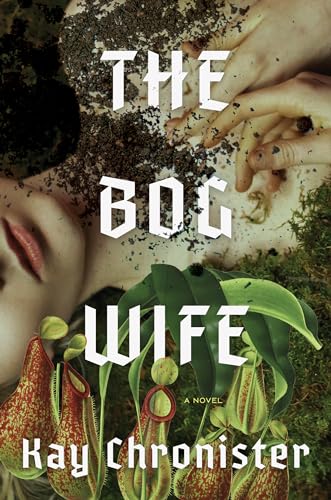
The Bog Wife by Kay Chronister is a 336 page standalone novel published by Counterpoint in 2024.

Genre/Subgenres:

Gothic, Contemporary Magical Realism, Mystery

Blurb:

In this atmospheric Appalachian gothic, the Haddesley siblings of West Virginia must unearth long-buried secrets to carve out a future when the supernatural bargain entwining their fate with their ancestral land is suddenly ruptured

Since time immemorial, the Haddesley family has tended the cranberry bog. In exchange, the bog sustains them. The staunch seasons of their lives are governed by a strict covenant that is renewed each generation with the ritual sacrifice of their patriarch, and in return, the bog produces a “bog-wife.” Brought to life from vegetation, this woman is meant to carry on the family line. But when the bog fails—or refuses—to honor the bargain, the Haddesleys, a group of discordant siblings still grieving the mother who mysteriously disappeared years earlier, face an unknown future.

Middle child Wenna, summoned back to the dilapidated family manor just as her marriage is collapsing, believes the Haddesleys must abandon their patrimony. Her siblings are not so easily persuaded. Eldest daughter Eda, de facto head of the household, seeks to salvage the compact by desecrating it. Younger son Percy retreats into the wilderness in a dangerous bid to summon his own bog-wife. And as youngest daughter Nora takes desperate measures to keep her warring siblings together, fledgling patriarch Charlie uncovers a disturbing secret that casts doubt over everything the family has ever believed about itself.

Brimming with aching loss and the universal struggle between honoring family commitments and the drive to strike out on one’s own, The Bog Wife is a haunting invocation of the arcane power of the habits and habitats that bound us.

Opening Line:

On winter nights, they burned heavy bundles of dried peat in the hearth and inhaled the scent of sacred ground burning while their father paced the length of the room, reciting the history of the Haddesley compact.

My Thoughts:

Anything that lives and does not live alone makes compacts.

This book is not horror, per se, but it’s still a great fit for spooky season! Described as “Appalachian Gothic”, it’s basically a family drama/saga about a group of adult siblings who struggle to know what to do when the compact between their family and the bog on their land doesn’t play out the way their father always instructed them it would when he died (to borrow words from another Goodreads review I got a real kick out of, the promised swamp tart is a no-show!) Have they failed as custodians of the bog? Did they perform the rituals wrong? Is the whole thing just totally insane…or a lie passed down through the generations?

We see this story unfold while following each of the Haddesley siblings: Eda, who has dedicated her life to making sure her family maintains the compact through ritual; Charlie, the eldest son who was always a disappointment as the one set to inherit the family legacy as patriarch; Wenna, the one who tried to escape it all and lived in the “real world” for ten years before returning for her father’s burial; Percy, the custodian of the bog; and Nora, who just wants the whole family to get along and to feel accepted as one part of the whole. Then there is the matter of their mother, the last bog wife, who disappeared over a decade ago…

The occult parts of the story were really interesting, and the tension was ratcheted up by discord among the siblings and their plight to understand what went wrong and how to fix it. I do have to admit that I felt let down by the last 50 pages–the resolution just had a very different feel from the rest of the book, which was a 5 star read for me. So altogether I’d probably call it 4.75 stars.

Goodreads

Bookstagram

Book Review: VICTORIAN PSYCHO by Virginia Feito

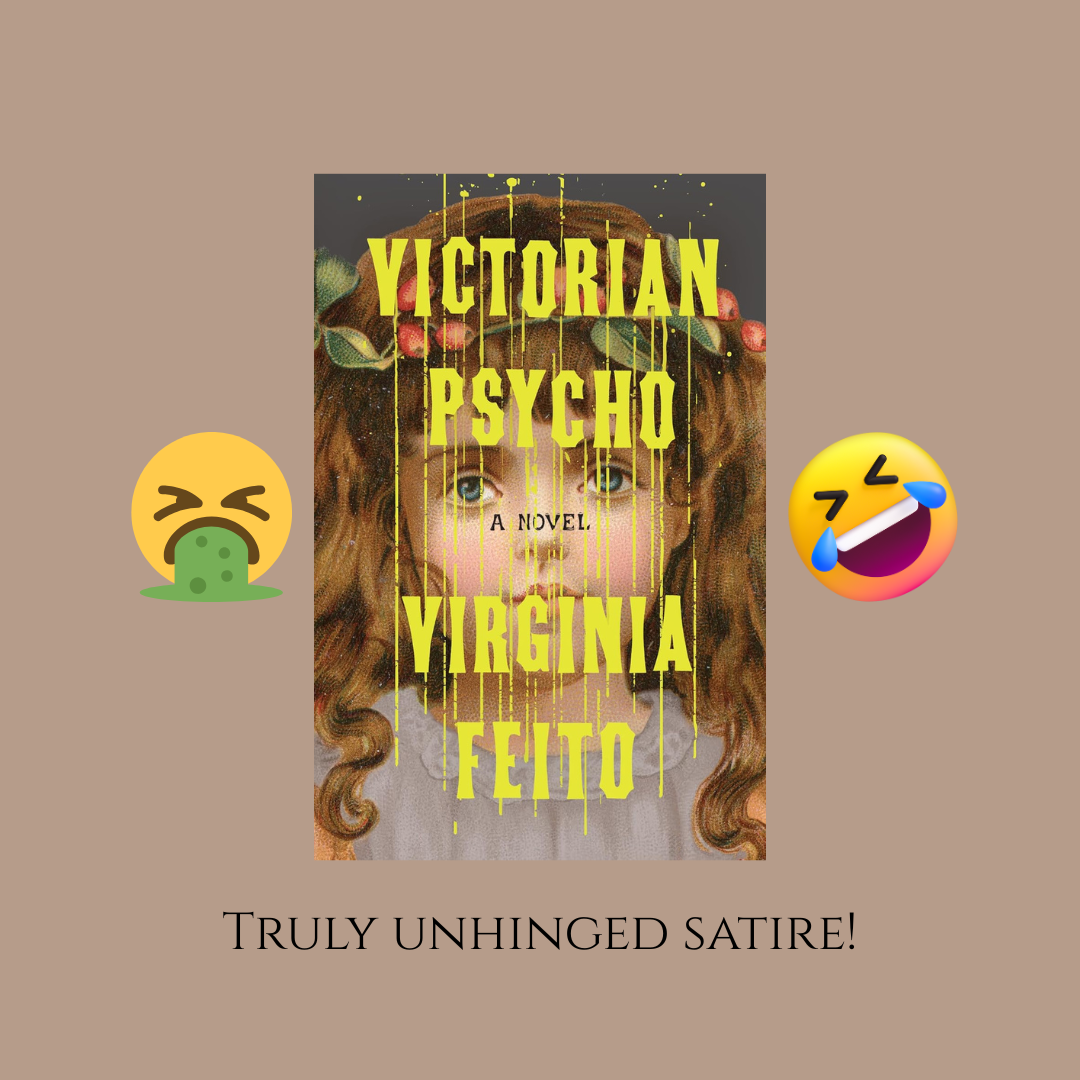
Victorian Psycho by Virginia Feito is a 208 page standalone novel published in 2025 by Liveright, imprint of W. W. Norton & Company.

Genre/subgenre:

Horror, Satire, Gothic, Historical Fiction, Dark Comedy

Synopsis:

From the acclaimed author of Mrs. March comes the riveting tale of a bloodthirsty governess who learns the true meaning of vengeance.

Grim Wolds, England: Winifred Notty arrives at Ensor House prepared to play the perfect governess—she’ll dutifully tutor her charges, Drusilla and Andrew, tell them bedtime stories, and only joke about eating children. But long, listless days spent within the estate’s dreary confines come with an intimate knowledge of the perversions and pathetic preoccupations of the Pounds family—Mr. Pounds can’t keep his eyes off Winifred’s chest, and Mrs. Pounds takes a sickly pleasure in punishing Winifred for her husband’s wandering gaze. Compounded with her disdain for the entitled Pounds children, Winifred finds herself struggling at every turn to stifle the violent compulsions of her past. French tutoring and needlework are one way to pass the time, as is admiring the ugly portraits in the gallery . . . and creeping across the moonlit lawns. . . .

Patience. Winifred must have patience, for Christmas is coming, and she has very special gifts planned for the dear souls of Ensor House. Brimming with sardonic wit and culminating in a shocking conclusion, Victorian Psycho plunges readers into the chilling mind of an iconic new literary psychopath.

Opening Line:

Death everywhere.

My Thoughts:

Well, that was wild!

I personally got 3 star book enjoyment from this one, but it has 5 star writing, so I guess I’ll compromise with 4.

This is basically super gory satire about the Victorian era. It was weird, and I often like weird books, but this style of weird wasn’t 100% to my tastes – although the absurdities did make me laugh out loud several times. I also prefer suspense and psychological horror to the straight up grotesque. It lacked the depth that really draws me personally as a reader into feeling connected to a story (and in this case, thank goodness for that!) But for what the author was going for, the writing really hits the nail on the head.

So clearly, I have mixed feelings on this one!

Examples of the humorous satire about a truly psychopathic governess living in Victorian times:

As advised by the Ladies’ Journal, I am clothed in a ‘plain and quiet style of dress; a deep straw bonnet with green or brown veil’ (brown, in my case, as the drab color blurs the identifying features further, obscuring my expression of unfathomable emptiness to resemble one a casual observer might mistake for solemnity).

When Mrs. Pounds makes an inquiry into her health, he scoffs at his wife’s ‘slight hysterical tendency’. She has been languishing on settees and refusing meals since witnessing the drowning of their youngest son.

‘Nothing a good rest devoid of intellectual strain can’t cure,’ Mr. Pounds says brightly.

‘Agree wholeheartedly,’ Mr. Fishal says. ‘Mrs. Fishal said writing energised her, so I took away all her quills and now she’s decreed that she’ll write in her own blood if she must.’

There is some good-natured tittering around the table, some good-natured shaking of heads. Women! Theatrical bitches.

If large quantities of gore in an effort to effect satire don’t bother you, you should most certainly read this book. But if you consider yourself on the squeamish side, you should probably give this one a pass.

Goodreads

Bookstagram

Book Review: THE HAUNTING OF MOSCOW HOUSE by Olesya Salnikova Gilmore

The Haunting of Moscow House by Olesya Salnikova Gilmore is a 383 page standalone novel published by Berkley in 2024.

Genre:

Historical Fiction, Horror, Gothic, Romance

Opening Line:

If someone from their past should catch a glimpse of the formerly aristocratic Goliteva sisters, they would find two wraiths instead of countesses.

My Thoughts:

…the ghosts wouldn’t have returned unless there was space for them among the living…to let them and the past in, maybe in hope of healing it and themselves.

Irina and Lili were Russian countesses, but after the revolution they are “former people” living at the mercy of the Soviet regime. In 1921 they live in their family’s Moscow estate with their grandmother, aunt, and young cousins, although electricity has long since been shut off and they have had to resort to selling valuable family heirlooms in order to be able to feed themselves. A group of Bolsheviks arrive one day and commandeer their home, forcing the family to move into the attic. But then things start happening in the house, frightening things, and people start dying.

A good portion of this book is historical fiction about post-revolutionary Russia, the Cheka, the Bolsheviks, the American Relief Administration providing former aristocrats with jobs helping to ease the famine. There are two separate romances, which I’m not sure were really needed. The Gothic part is due to the fact that the main characters live in a derelict mansion where spooky things are happening. The horror and folklore parts were by far the most interesting to me.

There is no slow, creeping build up of suspense here, as right from the get go our sisters are confronted up close with footsteps from behind, a growl, an earsplitting screech, something skittering past in the dark, glowing red eyes, an implosion of air throwing them off balance as furniture crashes and things smash, culminating with the discovery of a dead body in their home–all in one go. Well, okay then, you can’t have imagined ALL of that, I guess there’s no questioning an actual haunting going on here, then! (Although actually, Irina sees dead acquaintances sporting their fatal wounds appear before her very eyes at her dining table, and “still doesn’t believe in the supernatural, but it’s growing harder and harder to refute its existence”…ya think?!)

The last, I don’t know, 15% or so of the book really ramps up on the horror and excitement, and I enjoyed it the most.

The rest I only felt lukewarm about. There were a couple of things about the writing that I didn’t love. It is understood, even mentioned, that except when speaking to the Americans, everyone is speaking Russian and we’re just reading about it in English. So why mix the two languages in some sentences, like with, “Your family, nothing but upyrs” (vampires)? If all of those words were actually delivered in Russian, why present it mostly in English with one word randomly in Russian? It seems just because the author wants to impress.

Also, we are treated to several diary entries, one of which reads, “‘What happened, Marie?’ I demanded in rapid French.” No one would write like that in a diary. It’s like me writing, “Dear Diary, ‘What would you boys like for breakfast?’ I cheerfully inquired this morning”.

There was also a parakeet in the book, a somewhat anthropomorphized one that was never caged but just flew around the estate wheresoever she wished, and I couldn’t help but think, “Gee, there must just be bird shit all over that house.”

For me this was a case of “Come for the horror, stay only for the horror”, because the romances and the historical fiction just weren’t that engaging to me. But that Domovoy sure was!

Bookshop.org

Goodreads

Bookstagram

Book Review: LUCY UNDYING: A DRACULA NOVEL by Kiersten White

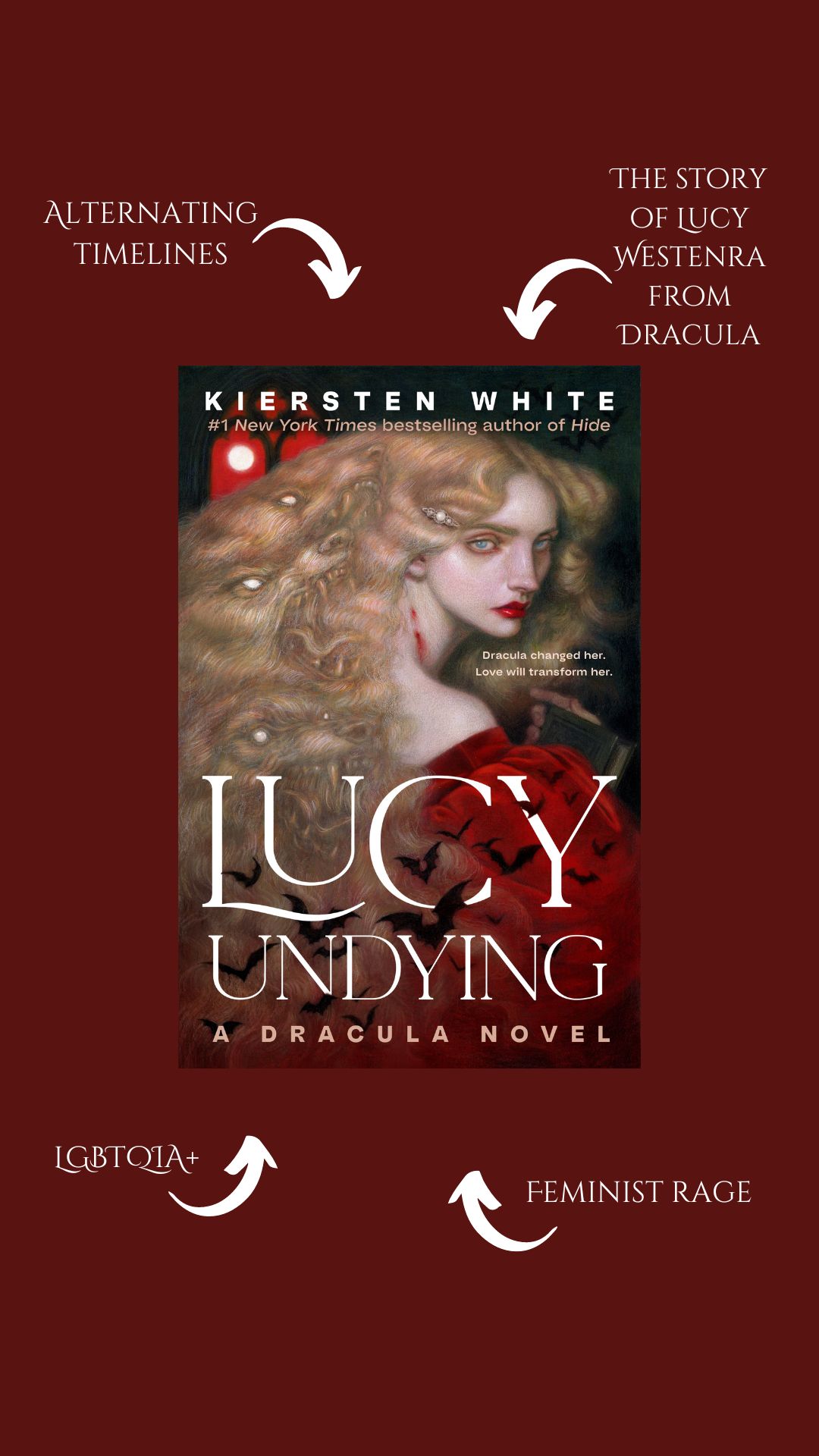
Lucy Undying: A Dracula Novel by Kiersten White is a 452 page standalone novel published in 2024 by Del Rey.

Genre/Subgenres:

Romance, Horror, Gothic, LGBTQIA+, Paranormal, Vampires, Retelling

Opening Line:

It starts the moment you look out the window.

Synopsis:

A vampire escapes the thrall of Dracula and embarks on her own search for self-discovery and true love in this epic and seductive gothic fantasy from the #1 New York Times bestselling author of Hide.

Her name was written in the pages of someone else’s Lucy Westenra was one of Dracula’s first victims.

But her death was only the beginning. Lucy rose from the grave a vampire and has spent her immortal life trying to escape from Dracula’s clutches—and trying to discover who she really is and what she truly wants.

Her undead life takes an unexpected turn in twenty-first-century London, when she meets another woman, Iris, who is also yearning to break free from her past. Iris’s family has built a health empire based on a sinister secret, and they’ll do anything to stay in power.

Lucy has long believed she would never love again. Yet she finds herself compelled by the charming Iris while Iris is equally mesmerized by the confident and glamorous Lucy. But their intense connection and blossoming love is threatened by outside forces. Iris’s mother won’t let go of her without a fight, and Lucy’s past still has Dracula is on the prowl once more.

Lucy Westenra has been a tragically murdered teen, a lonesome adventurer, and a fearsome hunter, but happiness has always eluded her. Can she find the strength to destroy Dracula once and for all, or will her heart once again be her undoing?

My Thoughts:

Forever is composed of nows.

Yas, queens!

The newest novel from Kiersten White focuses on the story of Lucy Westenra from Dracula. It is told through alternating timelines and POVs. For the first two thirds or so these primarily consist of excerpts from the journal Lucy kept before being turned into a vampire at age 19 in the year 1890, transcripts from current day Lucy’s talks with a therapist as she explains everything that has happened to her since then (a la Interview with the Vampire), and a narrative following a woman named Iris, who is trying to escape her abusive and controlling family and its company/MLM empire. Her connection to the rest of the story becomes apparent over time as hints are dropped like a trail bread crumbs. Later, we get several chapters from the POV of the Transylvanian count himself.

I was always good at moonlight, though, because moonlight isn’t real, either. It’s just a wan reflection of something else’s light.

This is the story of women who are expected, by their families and by society, to be a certain way, fit into a certain mold. These women may try to please these others so much that they are unable to even recognize who they truly are behind the act. They play at being meek and cooperative, but then no one pleased by their resultant vulnerability bothers to protect them when called for. The damage wrought by this kind of trauma can ultimately be cured by being wholly loved for exactly the people they are, nothing less and nothing more.

Dear, dear Mother, who loves like a knife, slicing me into ever smaller pieces until I’m exactly the shape that pleases her the most.

In that way, this winds up being a really sweet and inspirational sapphic romance story. It also has mysterious and Gothic elements, and the tension and dread of being constantly watched by those who believe they own you. Lucy’s story takes us from England to China to Istanbul, and through two World Wars. Eventually we are brought to the States to take on the horrifying company that will never willingly let Iris go, and even Dracula himself.

Speaking of…the character of Dracula was the least compelling here. Maybe that’s intentional as he thinks he’s the best thing since sliced bread and everyone should worship him, but after centuries of growth some of the women he’s screwed with realize he isn’t worth taking up any more space in their thoughts. These women, though – by the end of the story, I loved them so much! Over the course of her Unlife, Lucy met and…sure, “befriended”, a handful of other women turned into vampires by Dracula, and they wind up all being quite delightful in their own ways! Girl power!

First things first, though, we start this girls’ trip the proper way: arson and then a visit to my therapist.

Not just doom and gloom, there are some quite funny moments in this book as well. These are often provided by snarky and irreverent Iris, but not always. I got a real kick out of one of the vampires only just trying to learn about cell phones, sending a blurry picture of a squirrel. The recipient sends Who is this?, and the dear, sweet, insane vampire replies You mean what is this it’s a squirrel.

The main reason I decided not to go with 5 stars for this book was because it did seem overly long and dragged a bit in the middle. But when it did pick back up once the three timelines converged, I loved all of the ass-kicking, and the healing of trauma through being loved for one’s true self. Great stuff!

Thank you so very much to NetGalley and Del Rey for the eArc in exchange for my honest review.

Note: “Forever is composed of nows” is attributed to Emily Dickinson in this book

Bookshop

Goodreads

Bookstagram

Book Review: KING NYX by Kristen Bakis

King Nyx by Kristen Bakis is a 320 page hardcover standalone novel published February 27, 2024 by Liveright (W. W. Norton & Company).

Genres: Historical Fiction, Gothic, Mystery

Opening Line:

Last night I dreamed my husband came back.

“This woman cannot think, she feels.” So the novelist Theodore Dreiser once wrote about Anna Fort, wife of the crypto-scientist Charles Fort. It was this line that inspired author Kristen Bakis to write a story of Anna’s own, albeit a fictional one.

I had heard this book was a Gothic tale that was more about vibes than plot, and I supposed that is pretty much the case (there is certainly plot, but I do think I’d say the pacing is on the slower side). But there were a lot of other elements to this story that I was not expecting.

Anna’s husband writes about verified anomalies that science has failed to offer sufficient explanations for, and who then proposes his own rather outlandish theories. A wealthy recluse invites them to stay on his private island estate while Charles finishes writing his book. But all is not well on Prosper Island.

We learn a lot about Anna’s memories from before her marriage, at a time when she herself experienced something unexplainable and wound up having a mental break and spending time in a sanatorium. This history has her questioning when she can and cannot trust herself and her own thoughts and perceptions. She discovers that one can perform any number of mental gymnastics in order to keep one’s view of the world palatable.

Visitors to Prosper Island are made to quarantine in cabins in the woods for two weeks upon arrival, and it is here Anna and her husband meet another couple, a psychologist and his wife with an oddly antagonistic relationship, who are also guests of the eccentric Mr. Arkel. In fact, the story doesn’t actually arrive at the house itself until very near to the end, and then only briefly.

The story also includes: missing girls (pulled from the penal system and put into a school for domestic service), creepy automata (the most horrifying part of this book, IMO!), and a toy bird elevated to the status of deity. Oh, and several pet parakeets. I wasn’t expecting all of these elements, but they still wound up telling a decent Gothic mystery.

Bookshop

Goodreads

Bookstagram

Book Review: DIAVOLA by Jennifer Thorne

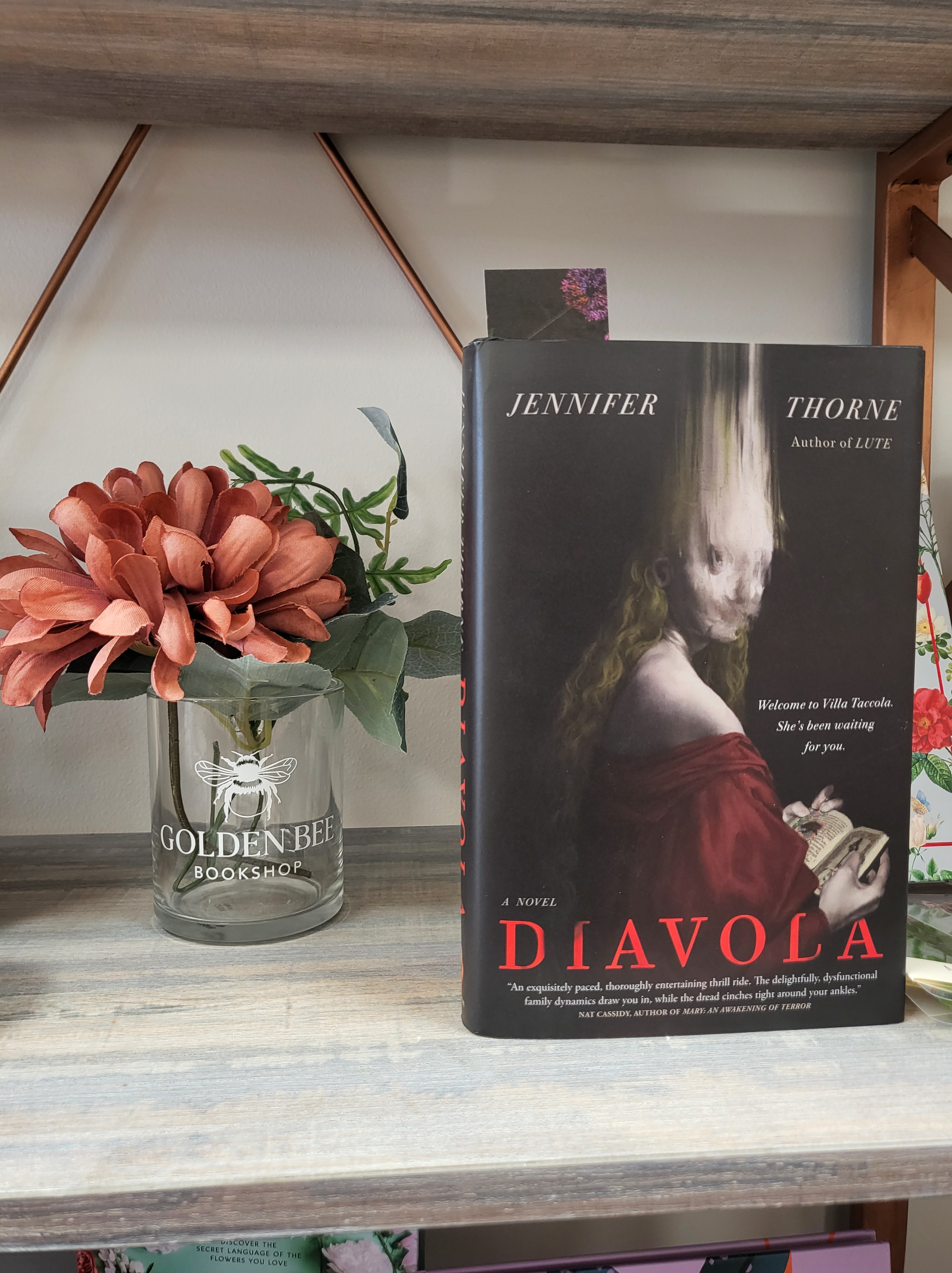
Oooh, there was so much to love about this chilling Gothic ghost story set in Italy!

Anna has long been the black sheep of her family and has prepared for the usual complaints and judgment when she joins them for a trip to Italy. They are staying at a picturesque villa that includes a modern addition built onto the original architecture…and a tower they are instructed to never unlock or enter.

Soon, it becomes clear that there is more than irritating relatives threatening what should be a peaceful vacation.

The setting was wonderful and evocative, and Thorne was able to make me feel like a tourist in Italy myself. Bellissimo!

I liked Anna a lot. She was smart, caring and compassionate to those who deserve it, and answers the insults slugged her way with perfect snark. I enjoyed the fraught interpersonal dynamics at first, but eventually they got on my nerves a bit, when everyone started blaming Anna for things it made no sense to blame her for.

The supernatural elements were deliciously creepy. The stressful family gathering introduced a feeling of tension, which only ratcheted up by increments as evidence of a haunting begin with the sounds of disembodied voices and doors slamming shut of their own accord, working up to Anna and her family being in real and imminent danger.

The pacing in different parts of the book seemed a bit unconventional, but it was quite engaging all throughout. And the story wound up going places I could not have imagined. 4.75 stars from me!

Bookshop

Goodreads

Bookstagram

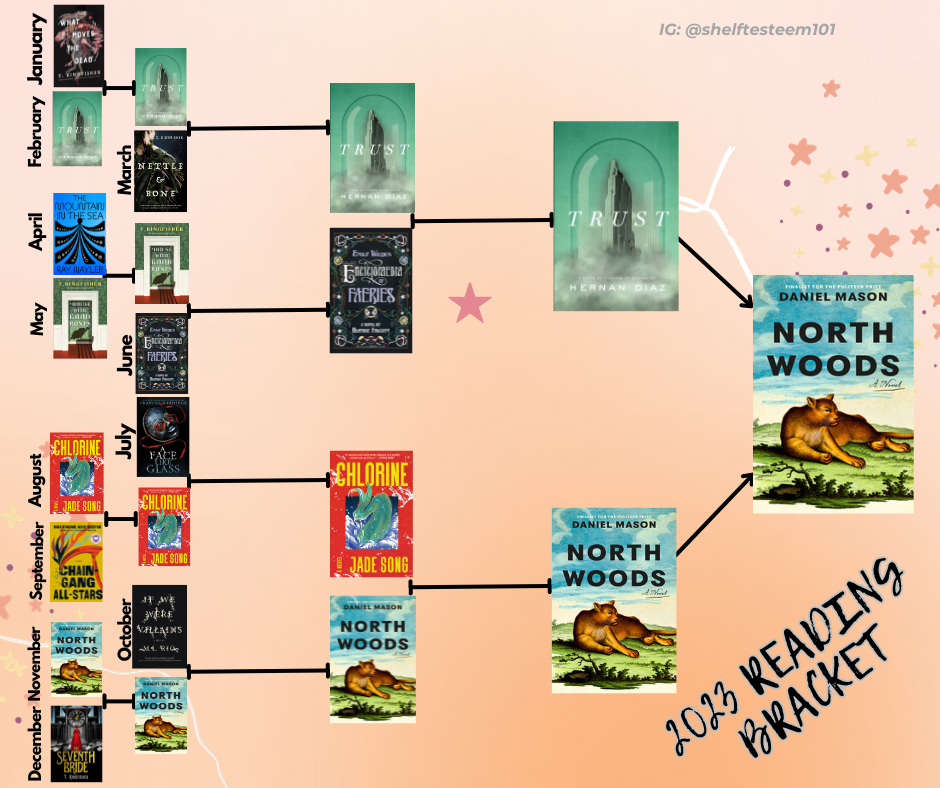
2023 Reading Bracket

Here is my final 2023 reading bracket! (Hopefully I’m not jinxing it by posting it 3 days before the end of the year–I’m in the middle of reading a book that is fine but not a favorite, here’s to hoping I don’t finish it and then read something Earth shattering in the next 72 hours!)

I reconsidered and made a change since the last time I posted this bracket, but the final outcome would have been the same either way. I think this supports what I already knew: I love me some Gothic fantasy and science fiction, but not quite as much as I love some moving literary fiction!

Books included as some of my favorite reads of the year: “What Moves the Dead” by T. Kingfisher, “Trust” by Hernan Diaz, “Nettle & Bone” by T. Kingfisher, “The Mountain in the Sea” by Ray Nayler, “A House with Good Bones” by T. Kingfisher, “Emily Wilde’s Encyclopedia of Faeries” by Heather Fawcett (I actually read an ARC of the sequel and enjoyed it even more, but decided not to count it as a 2023 favorite since it won’t be published until after the new year), “A Face Like Glass” by Frances Hardinge, “Chlorine” by Jade Song, “Chain-Gang All-Stars” by Nana Kwame Adjei-Brenyah, “If We Were Villains” by M. L. Rio, “North Woods” by Daniel Mason, and “The Seventh Bride” by T. Kingfisher.

Wow, that’s a lot of T. Kingfisher!

But the top honor goes to “North Woods” 🎉💯❤️

What was your favorite book you read this year?

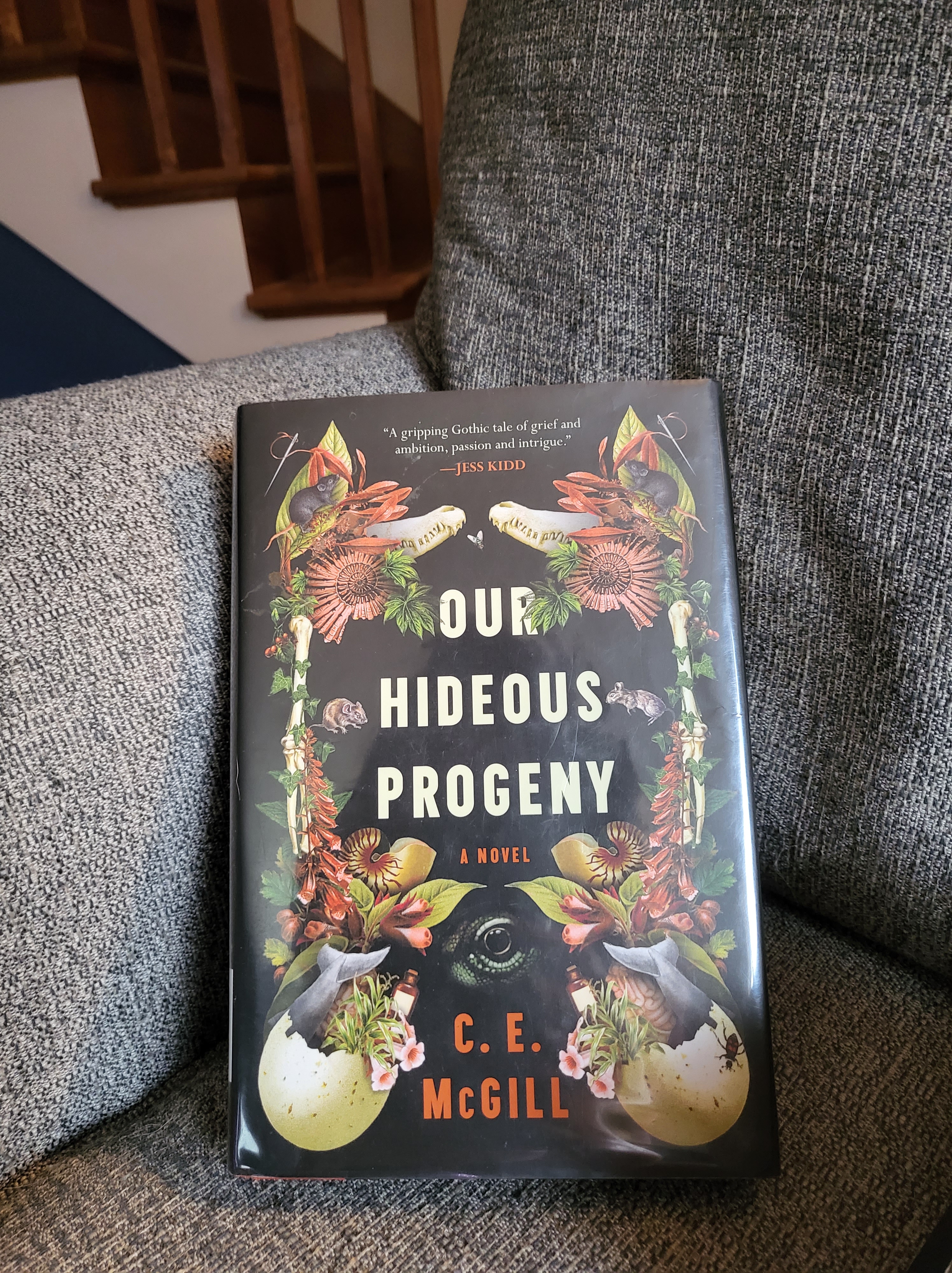
Book Review: OUR HIDEOUS PROGENY by C. E. McGill

Likely capping off my spooky season reading, this is OUR HIDEOUS PROGENY by C. E. McGill.

But I have never been a sensible soul. I have only ever, always, been angry.

In the mid-nineteenth century, Mary and her husband are scientists with particular interests in fossils and prehistoric creatures. As a woman (and a bastard), Mary has to work twice as hard to even attempt to be acknowledged in the field. Through poor decisions on her husband’s part, they find themselves at risk of losing the respect of the scientific community, as well as in great financial debt.

That is when Mary finds the notes of her great uncle, Victor Frankenstein.

“One cannot afford principles, if one is trying not to drown.”

According to the author’s note, they first pitched this story idea to their academic advisor as, “Frankenstein, but, like, with dinosaurs?” And I enjoyed it very much! It’s Gothic, concerns itself with academics in Britain’s scientific community in the Victorian era, deals with grief as well as caring over credibility, and is full of feminist rage. Although she is married to a man, Mary also develops romantic attachments to women. And, oh, how I adored that Creature! My only complaint would be that the pacing seemed a bit off, with things dragging a bit in the middle. Overall, I loved it!

It will not have been for nothing, I wanted to cry, no matter what happens-don’t you see? Don’t you see? Because it is already worth something. It is worth something, even in the dark. Even if no one else ever loves it but me.

Bookshop

Bookstagram

Goodreads

Book Review: LEECH by Hiron Ennes

Leech by Hiron Ennes is Gothic horror set in a post-apocalyptic future. After climate disaster and the backfiring of man-made technology drove people underground, they finally resurfaced when it was safe(ish) and rebuilt, reclaiming some of the knowledge that was lost through records that were spared.

The main character is actually a gestalt intelligence formed by a parasite that takes control of the human hosts it infects. It hoards the world’s recovered medical knowledge for job security, in order to stay relevant and needed by humanity, and to maintain its evolutionary niche.

While working as a doctor for the draconian baron in the frozen wilds of the North (stalked by beings with unknown origins, but plenty of mythological possible origin stories), they discover a new (probably ancient but newly resurfaced) parasite that threatens everything.

The world-building here is truly impressive!

Of course the baron lives in a crumbling chateau and his family is comprised of a strange cast of characters (and ghosts?). Consent and bodily autonomy are big players in the story that unfolds.

Not for the faint of heart, this tale is creative, creepy, and really quite wonderful! I can’t wait to see what this author does next.

Between this book, Mexican Gothic, and What Moves the Dead, I’ve learned that apparently parasite horror is my jam!

Bookshop.org

Bookstagram