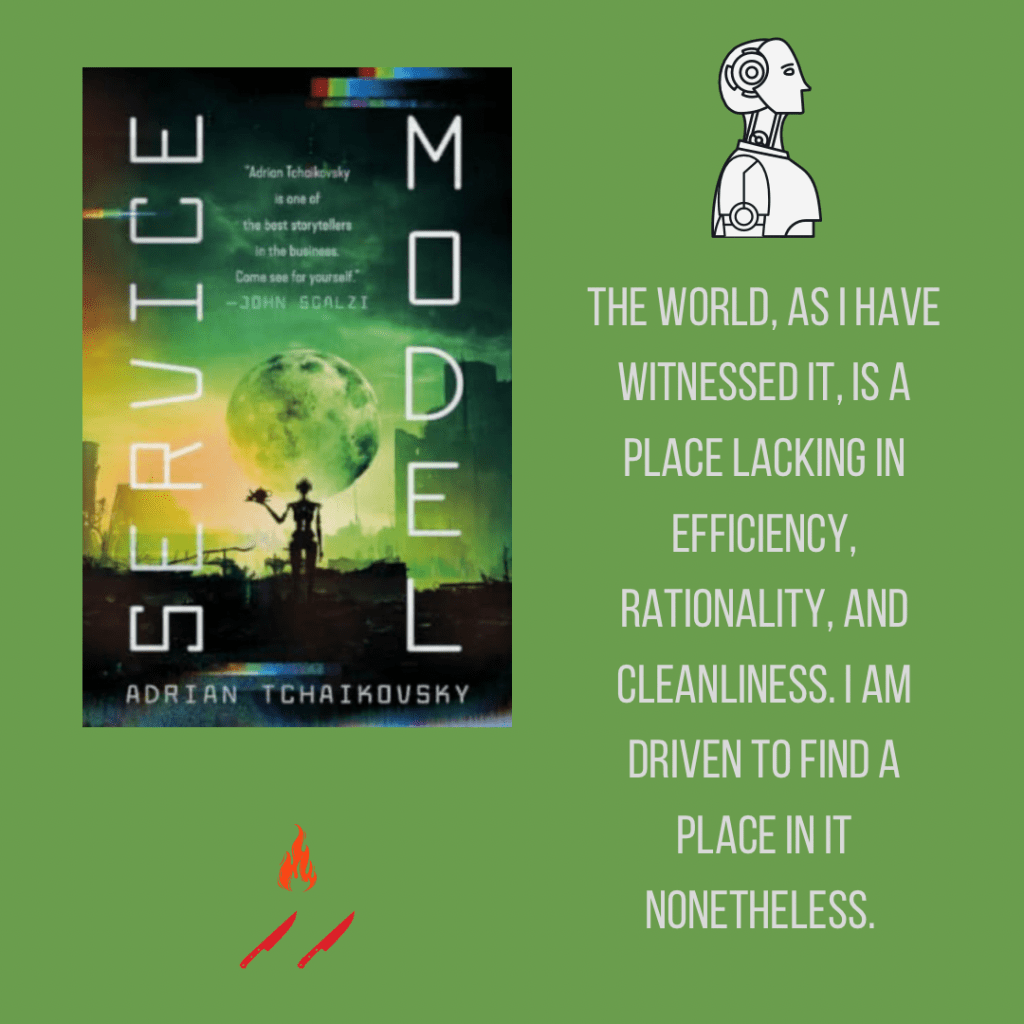
Book Review: SERVICE MODEL by Adrian Tchaikovsky

Service Model by Adrian Tchaikovsky is a 376 page standalone novel published by Tor Books in 2024.

Genre:

Science Fiction, Dystopian

Opening Line:

On activation each morning Charles’ first duty was to check his master’s travel arrangements for the day.

My Thoughts:

This book is clever and funny, but because of how grim it is, I’m not sure how much I actually enjoyed it.

A robot who finds himself no longer of use goes searching for purpose in a dystopian future in which humanity has pretty much wiped itself out, and poorly thought out programming leaves scores of inefficient robots dedicated to performing useless tasks.

..he completed two contrasting analyses of the situation using his best human-facing sophistication and decided that it was simultaneously of enormous credit to [his] ongoing fidelity and professionalism, and also that it was terribly pointless and sad.

Society collapsed thanks to a combination of factors, including climate, economics, problems with infrastructure, etc. Plus with all of the automated services provided through AI, people’s skills were not needed, and yet they were still looked down on for being lazy and idle. As civilization itself was dying:

”…I estimate that 45% were unaware of the situation or considered it fake, owing to the precisely curated news sources that they limited themselves to, whilst a further 30% were aware but did not consider it their problem and 20% were aware and actively cheering on the fact or profiting from [it]…A final 5% seem likely to have been directly and deliberately contributing to the collapse…”

Uncharles teams up with The Wonk, who wants to learn the meaning of it all. There is a moral that a kind and ordered society should be the goal.

Smart and oftentimes extremely amusing writing, but the bleakness and the infuriating absurdity of all of the situations Uncharles comes across during is journey into the world kind of canceled out some of the joy these things offered.

There is no sexual content in this book, and the only violence involving humans happens off the page.

I wish to report an error in the way that everything works. Charles, it is not an error. It is how things are.

Book Review: THE MORNINGSIDE by Tea Obreht

The Morningside by Tea Obreht is a 304 page long dystopian literary fiction novel (with the door left open for a hint of magical realism) first published March 19, 2024 by Random House.

“And I realized that I’d brought you into life at a time when everyone else’s debts had come due.”

This book is narrated by Sil, twelve years old for the majority of the story. She lives in a dystopian version of the world where climate change has really done a number on us. Everyone is expected to do their part to try to help the world heal. Eating meat is illegal. What food you do get depends on what ration cards the government has allotted you this week. Sil and her mother, refugees from a war torn country, are able to move to the once illustrious Island City as part of the Repopulation Program. With the changing tides, much of the island that was once inhabited now lies underwater. Sil and her mother move into the building where Aunt Ena serves as superintendent, a tower of apartments called The Morningside.

Sil’s mother and great aunt couldn’t be more different. As for the former,

The pronouncement of intent, the hubris of self-determination–these did not fit her notion of the universe

She teaches her daughter never to tell anyone their country of origin or to speak their mother tongue outside of the home, never to try to plan for the future but only meet challenges and opportunities as they come, and to leave the past in the past.

Ena on the other hand…

This was part of Ena’s magic. Familiarities you had come to take for granted were transformed by the act of her storytelling. Her version of things became the only one. She could change the reality of something you thought you’d known all your life.

With these two models in her life, even though Ena dies not long after their arrival in Island City (leaving the job of superintendent to Sil’s mother), Sil learns to look for signs of “the world beneath the world”.

I quite liked the writing and tone of this book, but I have to say, all of the characters annoyed me at one point or another. Sil would get so upset with Mila when she in fact was the one being unreasonable. I actually quite hated her mother at times. And at the end, you’re not 100% sure what the real story was with the reclusive wealthy artist Bezi Duras, or the daughter of the warlord Rait Belen, but I gather it’s supposed to be kind of left up in the air for the reader to continue thinking about. In fact, Sil even admits that what is true is not necessarily the point, or at least not the whole of it.

It had been wonderful to stand, however briefly, in the lighted rooms of Ena’s heart and know things as she knew them. But she was dead now. And were you really part of something if you were part of it alone?

This story is sort of unsettling and courageous at the same time, and I quite liked it, even if it’s the ideas I enjoyed more than the details. 4 out of 5 stars.

Bookshop

Goodreads

Bookstagram

Book Review: I WHO HAVE NEVER KNOWN MEN by Jacqueline Harpman

I cannot mourn for what I have not known.

This was a bleak but stimulating look at a potential dystopian future (similar to The Handmaid’s Tale, but much stranger and more disquieting).

I told myself that I’d been hypocritical and, since I had no one to lie to, I discovered that you can lie to yourself, which felt very strange

Groups of forty people (all men or all women) are caged together in bunkers all across the planet. One day an alarm sounds and all the guards run, never to be seen again. Our main character and her fellow prisoners are lucky enough to be in the cage that a guard was in the middle of unlocking when the alarm began to wail. The women don’t know where they are (is it even planet Earth?), where everyone else is, or why they were kept caged for years in the first place. They venture out into the desolate world and find ways to survive for the remainders of their lives. Since the MC is the only one who was a child when their incarceration began, she not only does not remember “normal” life before their imprisonment, she also is very aware that some day she will be the only person left alive.

I am the sterile offspring of a race about which I know nothing, not even whether it has become extinct. Perhaps, somewhere, humanity is flourishing under the stars, unaware that a daughter of its blood is ending her days in silence.

I just wish we got a little more of a hint at some answers about what actually happened to lead to things being the way they are. Beyond “it’s maybe not Earth”, the answers are completely left to the reader’s imagination.

Bookshop.org

Goodreads

Bookstagram

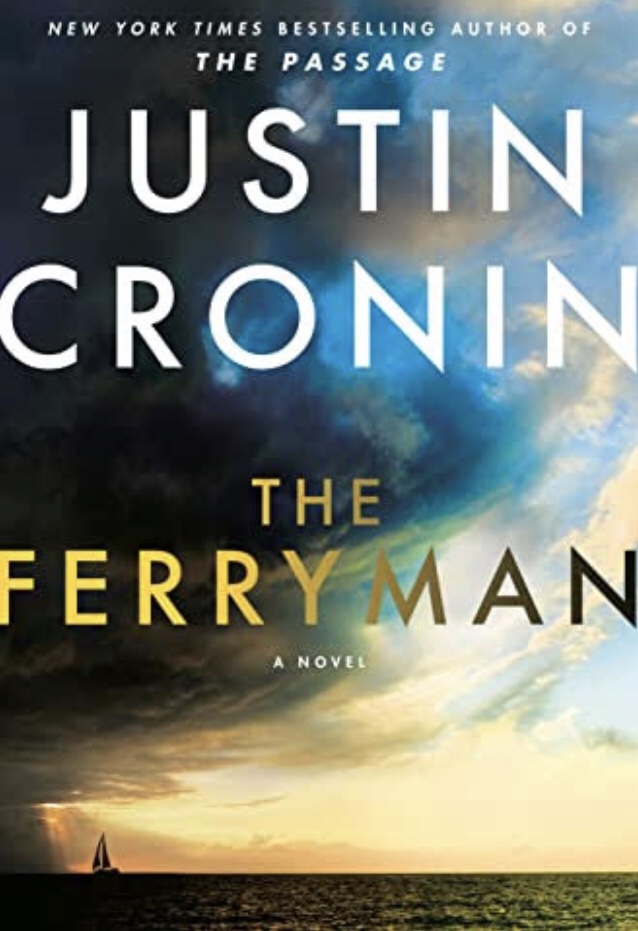
Book Review: THE FERRYMAN by Justin Cronin

From Justin Cronin, author of The Passage trilogy, comes a science fiction standalone, The Ferryman.

The end had been ordained in the beginning, the way the final chord was built into the first measure of a symphony

The people of Prospera aren’t sure what lays beyond the Veil that surrounds their archipelago state, but they know they’re lucky to be where they are. Prosperans live out idyllic lives, retire to the Nursery when their bodies begin to fail them, are overhauled both physically and mentally, then get reiterated into society as blank slates. This isn’t the case for support staff from the Annex, however, who perform menial labor for the Prosperans, while everyone is controlled by a police state. This world is dystopian for just as many as it is a seeming utopia for others. But how were these lines drawn?

I got The Truman Show vibes from the early parts of this book, not in tone, but in knowing that the world is not what it seems. But in this case, the reader is as clueless as to the truth as are all the characters. Most Prosperans are content in their ignorance, living happy life after happy life, though they may lack real love or anything to make it at all meaningful. On the other hand, the people of the Annex have built a religion around the idea of a day of Arrival (who will be arriving where?), and some people, like protagonist Proctor Bennett, want to learn the truth after being plagued by troubling dreams that are echoes of past iterations.

It was what the world taught us to do, but it was no way to live, and now, for the first time, I felt like I was waking up.

Proctor finds himself in league with others who are not satisfied with the status quo. Can they find their way out of what, for all intents and purposes, is the world itself? If so, what will they find outside its limits?

This book features some beautiful writing. I really loved it in the beginning, it fizzled out a bit for me in the middle, but then the final revelations were pretty good. I definitely had some questions, but to list them here would be spoilery. Overall it’s very well done.

TW: death of a child, suicide, adultery

Bookshop.org

Bookstagram

Goodreads

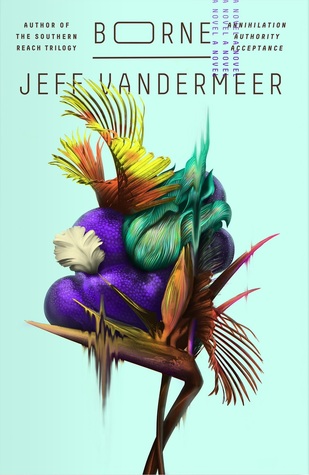
Book Review: BORNE by Jeff Vandermeer


Borne
“Am I a person?” Borne asked me.

“Yes, you are a person,” I told him. “But like a person, you can be a weapon, too.”

This was a wild dystopian speculative fiction story that asks some important questions and is quite touching at times. The land has been laid to waste by drought, conflict, and loosed biotech from the now-defunct Company. Rachel and Wick team up to take a stab at survival in this newly arranged city, and a real sense of tension is conveyed. Wick tries to maintain a hold on their territory through the dealing of information as well as his own psychoactive biotech, while Rachel scavenges for salvage off of which they can live. It’s during one of her outings that she finds something rather extraordinary.

This book left me bit confused as to the details of some of the science fiction elements. The who, what and why of the Company was never made clear, nor were specifics of some of the biotech it turned out. I think this was mostly a conscious choice by the author, but it did leave me a bit unsatisfied. Near the end I realized that the character of Mord had once been human, and it seemed like that fact had been revealed much earlier but I had somehow managed to either miss it or else forget it completely. The fact that the giant and vicious flying bear used to be human, and a former coworker of Wick’s at that, seems like a point that should be too significant to be missed/forgotten.

The story does many things right, though, and the best part by far was Borne himself – sweet and innocent and endlessly amusing.

“Those are three dead skeletons on the wall, Borne.”

“Yes, Rachel. I took them from the crossroads. I thought they would look nice in here.”

And yes, I maintain a belief in Borne’s inherent innocence. (And as it says in the book’s blurb, “in a world so broken that innocence is a precious thing.”) Borne simply does what he was designed to do, but because Rachel raises him with a human’s sensibilities, he feels great guilt and shame about his own nature. Which gives me all the feels!

“We all just want to be people, and none of us knows what that really means.”

And I sincerely hope to be able to subscribe to a book box someday(when I’m not so broke), because it turns out Quarterly’s most recent fiction Literary Box was curated by Vandermeer and included some of his own drawings of just what Borne looks like in some of his many forms. How fun is that?!


If you like science fiction of the speculative and dystopian variety, amusing plant/animal/salvage/biotech thingies, and The Feels, then give this one a read!