My reading went into sicko mode this year and I read nearly twice as many books as usual. My average rating on Goodreads was 3.6 stars. My most read genre was fantasy, followed by literary and then historical fiction. I wound up reading less science fiction (I’ll have to fix that this year!) and more thrillers and mystery than has historically been the case.
According to Storygraph I “delved into dark and intense narratives, unraveled intricate mysteries, and embarked on exciting adventures”. I preferred emotional stories, which comes as no surprise!
My reading goal for 2024 is to have a higher average star rating (above 3.6) by trying to land on books that are more of a hit for me and my tastes.
What are your reading goals for this new year?
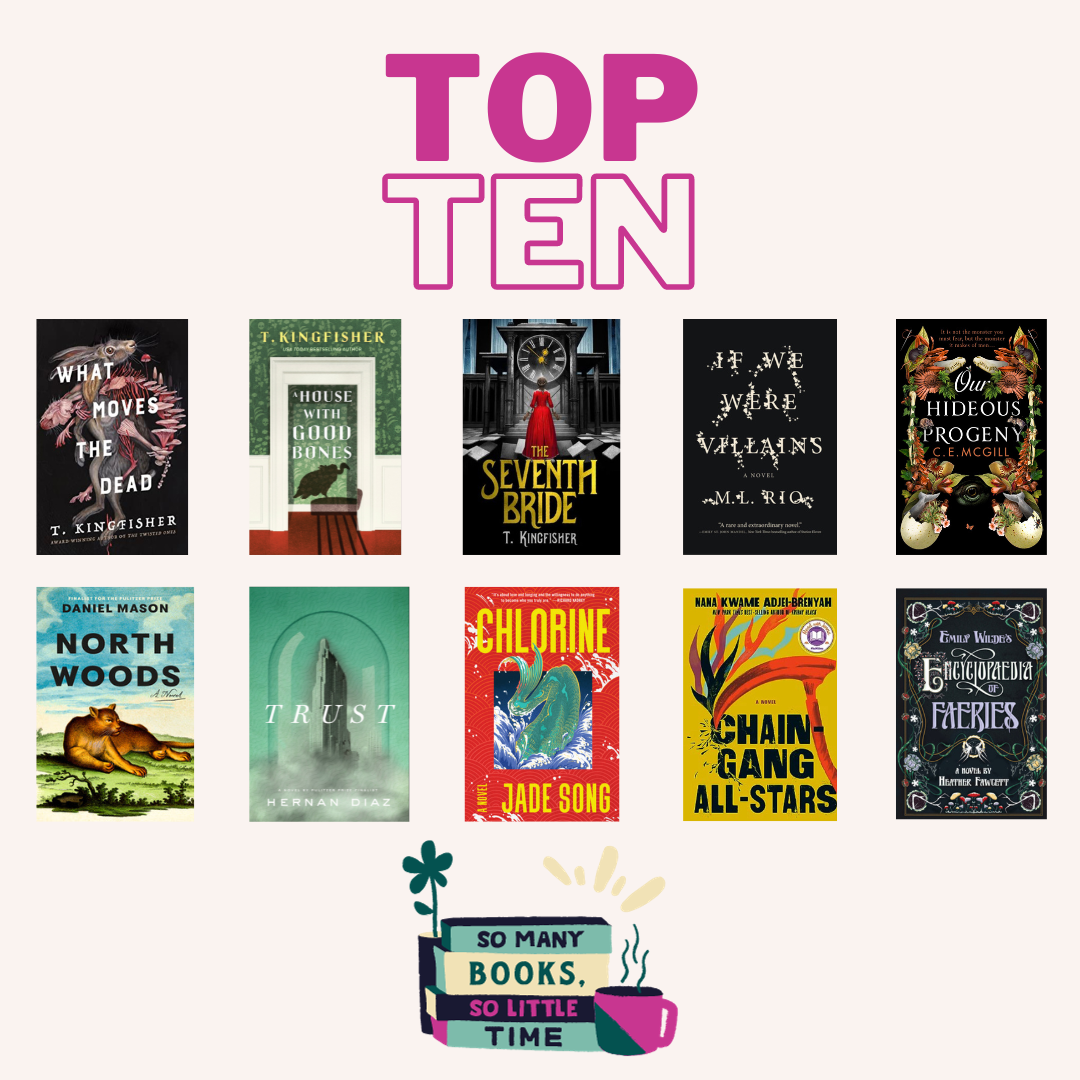
Books pictured: What Moves the Dead by T. Kingfisher, A House with Good Bones by T. Kingfisher, The Seventh Bride by T. Kingfisher, If We Were Villains by M. L. Rio, Our Hideous Progeny by C. E. McGill, North Woods by Daniel Mason, Trust by Hernan Diaz, Chlorine by Jade Song, Chain-Gang All-Stars by Nana Kwame Adjei-Brenyah, and Emily Wilde’s Encyclopaedia of Faeries by Heather Fawcett.
Of the books I read last month, only two had alternate cover editions.
The Warm Hands of Ghosts by Katherine Arden, author of The Winternight Trilogy (The Bear and the Nightingale) is an upcoming historical fantasy novel set during World War I (expected publication February 13, 2024). I think I have to give call this one a tie – I like the US cover because it’s rather unique, but the colors of the UK one are just so darn pretty!
Mrs. Caliban, written by Rachel Ingalls and originally published in 1982, is an interesting novella about a lonely house wife and a frog man. The US covers win this round for me; I like the US hardcover edition best, but the paperback is certainly not without its charm.
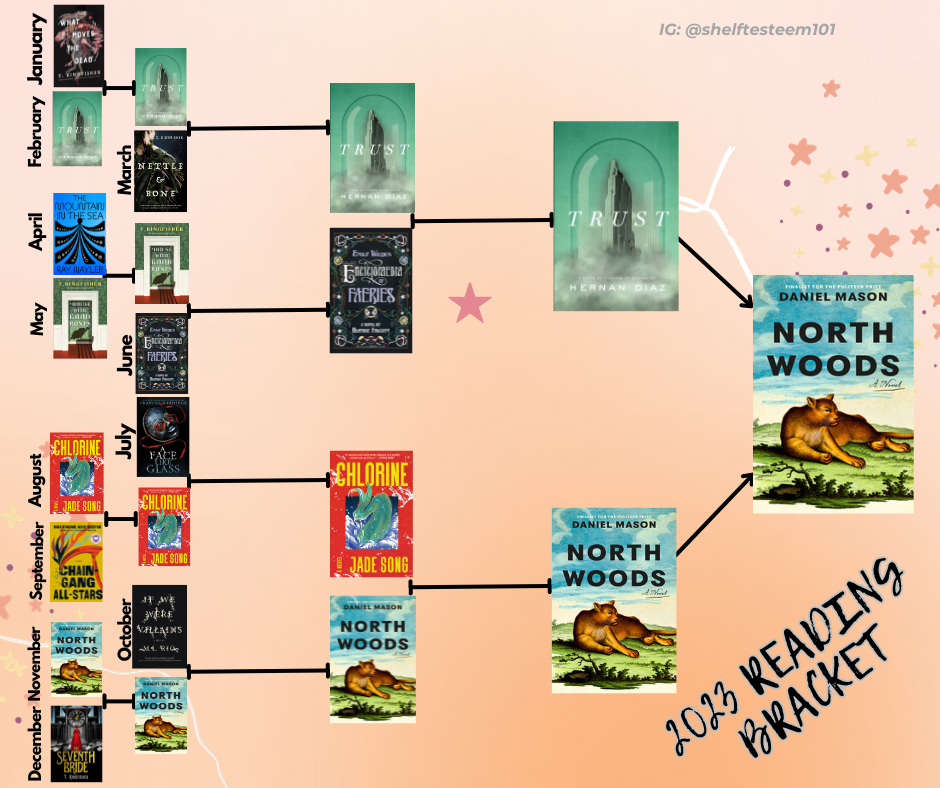
Here is my final 2023 reading bracket! (Hopefully I’m not jinxing it by posting it 3 days before the end of the year–I’m in the middle of reading a book that is fine but not a favorite, here’s to hoping I don’t finish it and then read something Earth shattering in the next 72 hours!)
I reconsidered and made a change since the last time I posted this bracket, but the final outcome would have been the same either way. I think this supports what I already knew: I love me some Gothic fantasy and science fiction, but not quite as much as I love some moving literary fiction!
Books included as some of my favorite reads of the year: “What Moves the Dead” by T. Kingfisher, “Trust” by Hernan Diaz, “Nettle & Bone” by T. Kingfisher, “The Mountain in the Sea” by Ray Nayler, “A House with Good Bones” by T. Kingfisher, “Emily Wilde’s Encyclopedia of Faeries” by Heather Fawcett (I actually read an ARC of the sequel and enjoyed it even more, but decided not to count it as a 2023 favorite since it won’t be published until after the new year), “A Face Like Glass” by Frances Hardinge, “Chlorine” by Jade Song, “Chain-Gang All-Stars” by Nana Kwame Adjei-Brenyah, “If We Were Villains” by M. L. Rio, “North Woods” by Daniel Mason, and “The Seventh Bride” by T. Kingfisher.
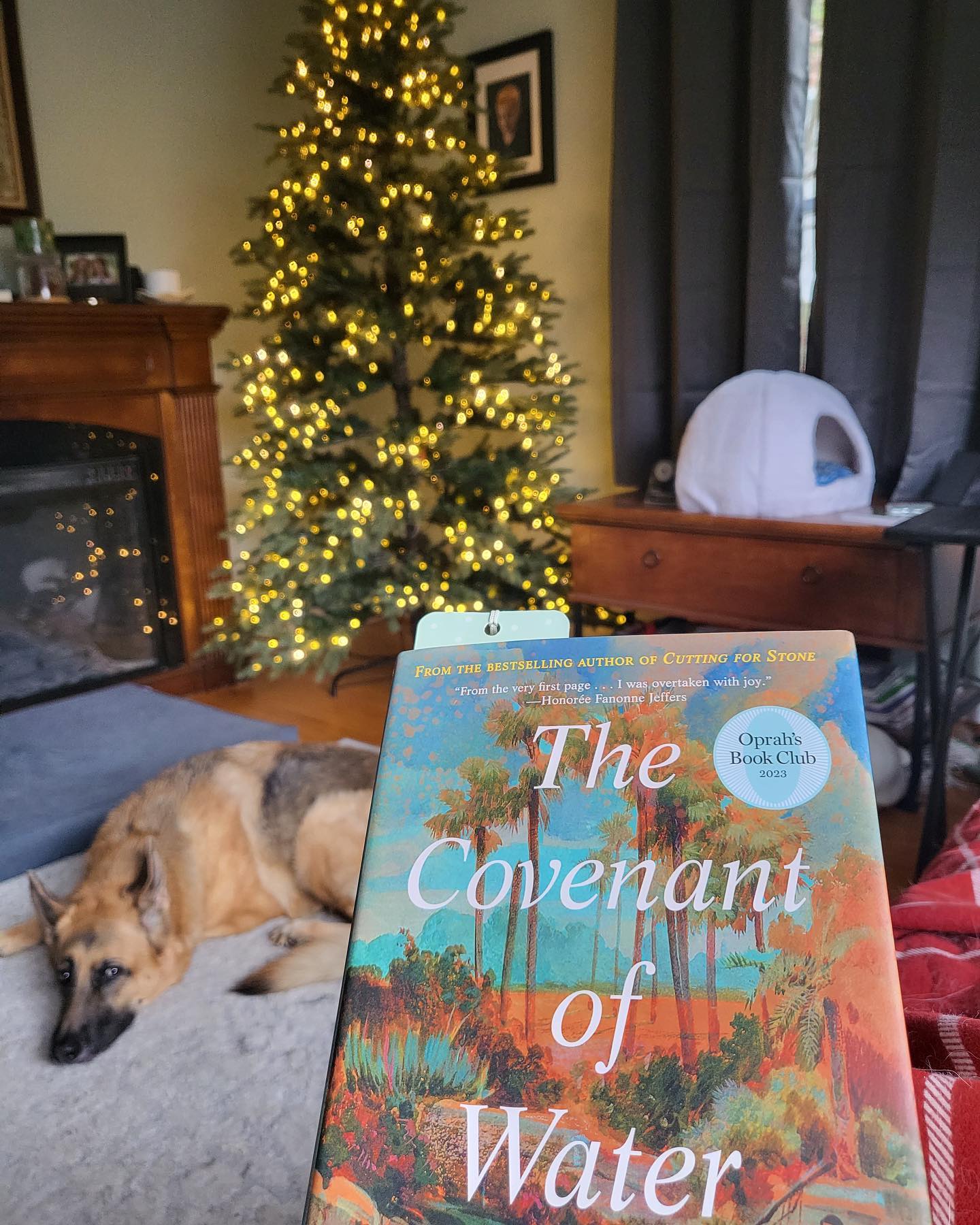
THE COVENANT OF WATER by Abraham Verghese is literary historical fiction. It is a long book that is in no hurry to get where it’s going, but if you just sit back and relax, there’s much beauty to enjoy along the way. If you require your books to be plot-driven and action packed, look elsewhere. If you prefer your reads constructed around realistic characters and their loves, griefs, sacrifices and ambitions, then treat yourself to the family saga told through evocative writing here.
The story follows three generations of a family in India over the course of the twentieth century. The crux is that there seems to be an inherited condition in the family, and there is hope that someday someone will figure out what it is and how to treat it. Alternate sections of the book tell of a Scottish surgeon who joined the Indian Medical Service; his story and that of the afflicted family eventually come together, but not in the ways you might expect.
Verghese expertly summons forth a strong sense of place and time, and readers find themselves inserted into daily life for Saint Thomas Christians in the part of India that eventually became Kerala. Sociopolitical issues, such as India’s caste system, are addressed in a adroit manner.
Some readers are turned off by the book’s many graphic surgical scenes, though I personally found them of great interest–which is no surprise, since my husband has had to repeatedly ask me to stop sharing stories from my job at the hospital with him. Different strokes for different folks!
I read a couple of lovely backlist books recently!
Rhea felt better. She was still going somewhere terrible, but she had a hedgehog, dammit.
I only just “discovered” Kingfisher this year and she is already an autobuy for me, and so I am now also working through her backlist. This book did not disappoint! I do feel like it took too long to get to the meat of the story–we know our main character is engaged against her wishes because her family cannot afford to say “no” to a Lord, but it takes quite some time for her to actually arrive at this nobleman’s home and learn exactly why being his bride is even so much more of a bummer than she feared. But this is one of the author’s earlier works, and I have not noticed the same issue with any of her other books.
Once we do learn about the other wives, some of whom are not…exactly…living human beings, as well as just what is at stake, this is a darkly fun adventure as the main character races to try to save herself and the others. The resolution was bit too hurried and neat IMO, but the characters and quests undertaken are just so imaginative and…well, darkly fun!
The narration also includes some of the author’s trademark wit and humor.
She clung to the tile, and eventually she stopped screaming, because it didn’t seem to be helping.
I am so excited to read more of her work!
Beautifully written queer retelling of Arthurian legend from the POV of the knight Percival. It’s magical, it’s moving, and it’s very human at its core…while also being, you know, not fully human. The book itself, the cover and the handful of illustrations inside, are lovely!
Of the books I read in November, only a few have different US and UK book covers. Which do you prefer?
While the color scheme of the US book cover for Cara Hunter’s Murder in the Family is more eye-catching, the UK version seems more thematically appropriate to me, and gets my vote.
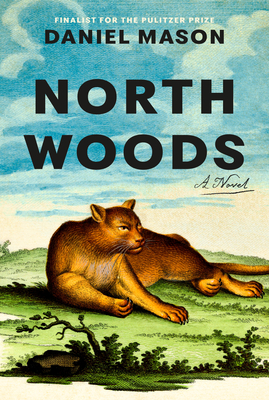
North Woods by Daniel Mason is one of my absolute favorite reads of the year – possibly even THE top read! That being said, no offense to the catamount, but I prefer the UK book cover.
The Kind Worth Killing by Peter Swanson has four different covers, one for both hardcover and paperback editions in the UK and US. Personally, the US paperback version speaks to me the most, but overall I kind of just feel “meh” about all of them.
There aren’t many things I find more intriguing than learning about the journey that begins with finding unidentified human remains, then studying them and investigating to discover who they belonged to, and ultimately, it is hoped, what happened to them.
I have an anthropology degree I’ve never used (changing career tracks and attending nursing school immediately after obtaining it), but have continued my lifelong interest in the subject, most especially with forensic anthropology. I read popular science books that are published on the topic. Oftentimes these are written by scientists in a very factual manner (like Sue Black’s survey of the human skeleton, including examples of specific cases she attended and what she was able to learn about a person from particular bones). This book takes a different approach. Written by a podcaster/writer/researcher/English professor, it describes the investigation into a specific Jane Doe’s identity with a narrative that includes the day to day process of planning and conducting the research.
I assume the decision was made to present it this way to make it more relatable, maybe? More like a story than strictly informational? However, for me, this made for a 50% absolutely fascinating read, and 50% boring drag. I honestly could not have cared less what hairstyle complemented Dr. Amy Michael’s cheekbones, or about the author’s skin care routine or keto diet; nor all the times the author ordered a Coke (Coke Zero twice at Mexican restaurants, Diet Coke at the trampoline park), the times she ordered a salad (including the time it came without dressing), all the times she flew Delta, and whether she then traveled to her hotel via rideshare or however else. I just wanted to get back to the matter at hand!
I also grew a little bored with the explanations of certain science topics with which I was already familiar, but of course the book couldn’t and shouldn’t just assume all readers are already brushed up on those. What I DID find super interesting was the specifics on the research and investigation done to identify this specific person, and several other Does brought up along the way. I also appreciated that the author includes in her writing the names of all the professionals who contributed, as well as some programs and nonprofits that readers might choose to look into more on their own.
Looking past the filler I did not care for, there was still plenty of great interest. Whether you’re a fan of true crime content or forensic anthropology and genealogy, you’ll probably find a lot to like in this book.
Sometimes, overwhelmed, she retreats into the forests of the past. She has come to think of them as her private Archive, herself an Archivist, and she has found that the only way to understand the world as something other than a tale of loss is to see it as a tale of change.
The gorgeous, lyrical prose of North Woods by Daniel Mason transports readers to a parcel of land and shows them the changes it undergoes over the course of centuries. A love poem for nature, it teaches of the land’s native flora and fauna, as well as how various outside seeds, spores, insects, and microorganisms make their way there and work changes upon it. Each vignette tells of the succession of people who find their way onto this land, live out their messy lives there, and leave their own indelible marks.
Interspersed with fictional primary accounts such as letters, songs, and speeches, we get peeks into the lives of several generations of people. There are the lovers who flee their Puritan Massachusetts colony to make a life for themselves in the woods, the woman and her child taken captive by native peoples, the escaped slave making her way north to Canada. There is the ex-soldier apple orchardist and his twin daughters, and the landscape painter harboring an illicit love in his breast (“Nature doing her best to draw me into her cloak of melancholy, but I have the memory of my friend”). The robber baron with dreams of a hunting lodge, the vulnerable woman who accidentally invites danger to her home, and the schizophrenic whose hallucinations might be more than they seem (“Diabolical tools, a ruptured earth, words which froze in winter; were it a poem, not a disease, she might find it fascinating”). The amateur historian looking to dig up the past. And then there is the wildlife that makes the place its home in between the people. Sprinkled amongst the stories are love, lust, murder, art, and more.
This literary novel is not for readers looking for fast-paced plot driven stories. I had to take my time reading each line, allowing myself to fully absorb the beauty of it all. And I loved every minute of it!
”What…What are you doing?” she asked groggily. “Just seeing what it’s like to love you when I can’t see you.”
Shark Heart by Emily Habeck is a bittersweet story about life and love.
The world in this book is identical to our own except for one key difference: some people develop a disease that causes them to mutate into a different species. When married couple Wren and Lewis learn that the latter is transforming into a shark, it’s analogous to learning one’s partner has a terminal illness. Or when a relationship undergoes anything unexpected that completely changes how things were “supposed” to be.
Wren is practical, Lewis is a dreamer. When they exchange their wedding vows, they could have never imagined how different their lives would look after only a year of marriage.
In their innocence, they failed to grasp the labor of losing a partner, how the tasks of simple existence would become logistical feats and one person’s burden.
This is a character-driven literary novel told in parts (three, I think), with some “chapters” being only a sentence or two long. In addition to the story of Wren and Lewis, the middle section tells about Wren’s mother, Angela, getting pregnant as a teenager and then trying her best to parent after receiving a life-changing diagnosis of her own. The book is chock full of love and grief, and learning to love with both. It is lovely and sad, although it does end on a hopeful note.
Wren no longer sees life as a long, linear ladder with a beginning, middle, and end. Instead, she considers how life is like a spiraling trail up a mountain. Each circling lap represents a learning cycle, the same lesson at a slightly higher elevation. Wren realizes she likes to rest as much as she likes to climb. She begins to enjoy the view.






 Jessica Crawford