
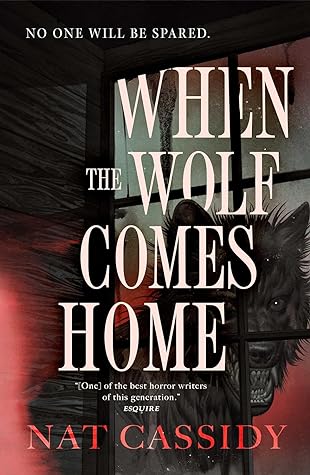
Book Review: WHEN THE WOLF COMES HOME by Nat Cassidy

When the Wolf Comes Home by Nat Cassidy is a 304 page novel published in 2025 by Tor Nightfire.

Genre:

Horror, Paranormal

Blurb:

One night, Jess, a struggling actress, finds a five-year-old runaway hiding in the bushes outside her apartment. After a violent, bloody encounter with the boy’s father, she and the boy find themselves running for their lives.

As they attempt to evade the boy’s increasingly desperate father, horrifying incidents of butchery follow them. At first, Jess thinks she understands what they’re up against, but she’s about to learn there’s more to these surreal and grisly events than she could’ve ever imagined.

And that when the wolf finally comes home, none will be spared.

Opening Line:

Daddy is roaring.

My Thoughts:

What a wild ride!

Nat Cassidy’s horror pulls no punches, so make sure to read the content warnings at the beginning of the book, but honestly I thought they made it sound way worse than it actually was. His writing is as entertaining and humorous as it is gory (…well, maybe not quite – it’s pretty gory!) This time around, it’s also really touching.

Jess finds herself in charge of a terrified young boy on the run from his father, and neither might be quite what they seem (if you prefer stories rooted firmly in reality without any speculative/fantastical elements, look elsewhere). This is a road trip adventure that will keep readers on the edge of their seats while also pulling on their heart strings. A theme of this book is the old FDR quote about the only thing to fear being fear itself. I was riveted, amused, and loving the journey…

BUT THEN.

This was a 5 star read for me right up until a resolution I was deeply unhappy with. I suppose it was an ending that made a good deal of sense, but certainly it could have gone another way.

Despite how upset I was with how the author chose to conclude this book, it’s still true that I loved the experience of reading it overall, and so 5 stars it is–but just know I am currently not speaking to Nat Cassidy (but will continue reading anything he writes)!

P.S. As an 80s kid myself, I can confirm Who Framed Roger Rabbit was terrifying
Goodreads

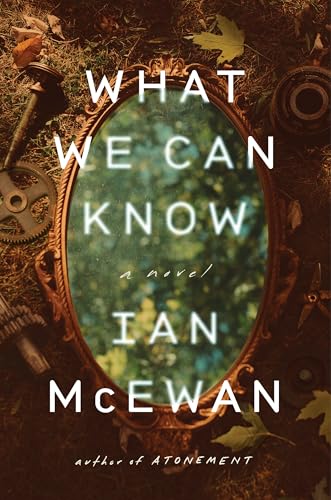
Book Review: WHAT WE CAN KNOW by Ian McEwan

What We Can Know by Ian McEwan is a 320 page novel published by Knopf in 2025.

Genre:

Literary Fiction, Speculative Fiction

Synopsis:

2014: A great poem is read aloud and never heard again. For generations, people speculate about its message, but no copy has yet been found.

2119: The lowlands of the UK have been submerged by rising seas. Those who survive are haunted by the richness of the world that has been lost.

Tom Metcalfe, an academic at the University of the South Downs, part of Britain’s remaining island archipelagos, pores over the archives of that distant era, captivated by the freedoms and possibilities of human life at its zenith. When he stumbles across a clue that may lead to the lost poem, a story is revealed of entangled loves and a crime that destroy his assumptions about people he thought he knew intimately well.

What We Can Know is a masterpiece, a fictional tour de force that reclaims the present from our sense of looming catastrophe, and imagines a future world where all is not quite lost.

Opening Line:

On 20 May 2119 I took the overnight ferry from Port Marlborough and arrived in the late afternoon at the small quay near Maentwrog-under-Sea that serves the Bodleian Snowdonia Library.

My Thoughts:

This is a story in two parts.

The part readers are presented with first takes place one hundred years in the future (which is chronologically after the second part). A university history professor is researching a “lost” poem from 2014 (I think; thereabouts, at least). The poet wrote it for his wife, recited it at a dinner party for her birthday, and then gifted her the only copy of it in writing. It was never published, but became famous by word of mouth and by dint of the air of mystery created by its absence, and the rumors created thereby. Going through all the primary records from the time period before the cataclysmic climate crisis has the historian reading all of the emails and text messages of the poet and everyone in his circle. He also reads the journals of the poet’s wife, Vivien. He believes he has come to know this woman as intimately as a close friend. But then the second part of the story is a sort of memoir of Vivien’s, and it goes to show just how limited one’s understanding of another person can really be when going only by the material evidence left in their wake.

Honestly, the first half of book was pretty rough. I was enjoying the story and the narrative conceit, but the style it was written in was a bit of a challenge to get through. It was pretty dry at times, with long blocks of text of information that had my eyes glazing over. Several times during this part of the story I found my mind had wandered and I was just skimming the words – sometimes I bothered to go back and reread what I missed, sometimes I didn’t.

But the payoff of the second half, and what it does to the first, was worth it. Seeing Vivien’s truth juxtaposed to the interpretation of an academic a century later was a nice touch.

Note: You may want to skip this one if you have a loved one with dementia! Also if you require likeable characters (the first part had these, the second did not other than the one with Alzheimers, and that is a ROUGH storyline)

Book Review: AMITY by Nathan Harris

Amity by Nathan Harris is a 320 page standalone novel published in 2025 by Little, Brown and Company of Hatchette Book Group.

Genre:

Historical Fiction

Synopsis:

A gripping story about a brother and sister, emancipated from slavery but still searching for true freedom, and their odyssey across the deserts of Mexico to finally reunite, all while escaping a former master still intent on their bondage

New Orleans, 1866. The Civil War might be over, but formerly enslaved Coleman and June have yet to find the freedom they’ve been promised. Two years ago, the siblings were separated when their old master, Mr. Harper, took June away to Mexico, where he hoped to escape the new reality of the post-war South. Coleman stayed behind in Louisiana to serve the Harper family, clinging to the hope that one day June would return.

When an unexpected letter from Mr. Harper arrives, summoning Coleman to Mexico, Coleman thinks that finally his prayers have been answered. What Coleman cannot know is the tangled truth of June’s tribulations under Mr. Harper out on the frontier. And when disaster strikes Coleman’s journey, he is forced on the run with Mr. Harper’s daughter, Florence. Together, they venture into the Mexican desert to find June, all the while evading two crooked brothers who’ll stop at nothing to capture Coleman and Florence and collect the money they’re owed. As Coleman and June separately navigate a perilous, parched landscape, the siblings learn quickly that freedom isn’t always given—sometimes, it must be taken by force.

As in his New York Times bestselling debut The Sweetness of Water, Nathan Harris delves into the critical years of the Civil War’s aftermath to deliver an intimate and epic tale of what freedom means in a society still determined to return its Black citizens to bondage. Populated with unforgettable characters, Amity is a vital addition to the literature of emancipation.

Opening Line:

I had few pleasures to call my own.

My Thoughts:

This is a work of historical fiction taking place in the American South and Mexico in the years immediately post-Civil War. POVs alternate between siblings Coleman and June, servants of the family who owned them as slaves before the North’s victory freed them. Still stinging from the Confederacy’s loss, the patriarch of the family takes June with him as he joins a group of other disgruntled Southerners who travel to Mexico in order to establish a new mining town and get out from the under the laws of the Union. Later, the man’s wife and daughter, along with Coleman and the family dog, strike out to join them. The journey presents a multitude of dangers and interesting characters – criminals, Mexican soldiers, Black Seminoles, and others.

What I liked about this book included the setting and atmosphere. There is the harsh beauty of the desert, the chapparal and mesquite trees beneath the baking sun, but also the towns strung along their path south, which reminded me of being ensconced in the world of Red Dead Redemption 2. This video game takes place about 30 years later, but I could easily picture Arthur Morgan and his outlaw companions riding their horses through the territories of this book.

Also enjoyable was the character of Coleman, a former slave and current servant who is happiest lost in the pages of his books, taught himself academics and proper comportment both from the books assigned to the daughter of his employers for her education, and who has a sweet bond with the book’s canine character, Oliver. Additionally, there is a side character who exhibits some nice personal growth.

What didn’t work so well for me is a bit harder for me to name. I just wasn’t that engaged in the plot, which meandered at times (particularly during June’s page time) without a real sense of urgency or expected destination, figuratively speaking. In this way I suppose the pacing was a bit off, and I certainly wouldn’t use the word “gripping” to describe my own reading experience. At the conclusion of the book I thought to myself, “Well that’s nice,” but it really isn’t anything that I anticipate staying with me for long now that I have finished reading. I guess I appreciated the vibes more than the story.